Non surgical treatment for AVN - Avascular Necrosis for pain relief, restoration of joint function and Joint Preservation.
Non-surgical, expert led, comprehensive treatment for AVN of the hip and other bones, identifying and addressing the root causes - preserving the natural joint through holistic integration of Ayurvedic medicines, Panchakarma, Physiotherapy with Supplements, Diet and Lifestyle changes.
Conditions We Treat in Avascular Necrosis
Where avascular necrosis can occur
Avascular necrosis most often affects the hip, but it can develop in any bone whose blood supply is interrupted. Our focus and deepest experience is with hip AVN — the most common form — and we assess and advise on AVN wherever it occurs.
Hip
femoral head
The most common site — 70–80% of all AVN, and it often affects both hips. This is where our clinical experience is deepest.
Knee
femoral condyle / tibial plateau
Affects the bone surfaces at the knee, and includes spontaneous osteonecrosis of the knee (SONK).
Shoulder
humeral head
The second most common site, often after a fracture or with long-term steroid use.
Ankle
talus
Usually follows an ankle or talus fracture, as the talus has a fragile blood supply.
Wrist
scaphoid & lunate
AVN of the lunate bone is known as Kienböck's disease; the scaphoid can be affected after a fracture.
Foot
metatarsal head — Freiberg's disease
Affects the forefoot, more often in younger, active people.
In children
Legg-Calvé-Perthes disease
Childhood AVN of the hip; early management protects the growing joint.
Affected at a site not listed here, or not sure? Book an assessment — our physicians evaluate AVN at any joint.
What causes avascular necrosis?
AVN develops when the blood supply to a section of bone is cut off. The causes fall into two broad groups — after an injury, and without any injury.
After an injury (traumatic)
A fracture or dislocation — most often of the hip, wrist (scaphoid), or ankle (talus) — can physically damage the blood vessels that feed the bone.
Without an injury (non-traumatic)
- Long-term corticosteroid (steroid) use — the single biggest non-injury cause
- Heavy or prolonged alcohol use
- Sickle cell disease and other blood disorders
- Autoimmune conditions such as lupus (SLE)
- Other causes — Gaucher's disease, decompression sickness (in divers), radiation therapy, and some HIV treatments
In about 1 in 5 cases, no clear cause is found (idiopathic).
How avascular necrosis is diagnosed
AVN can be present before it shows on an ordinary X-ray — which is exactly why early, accurate diagnosis matters. MRI is the gold standard: it can detect AVN in its earliest stages, often before any collapse of the bone, and a characteristic “double-line sign” on the scan is highly specific to AVN. X-rays, CT, and bone scans each add information at different stages.
Catching AVN early — before the joint surface collapses — gives the best chance of preserving the joint, so we investigate persistent joint pain thoroughly rather than waiting for X-ray changes to appear.
Our Physicians for Avascular Necrosis
Experienced Ayurvedic physicians who lead treatment in this clinical area.
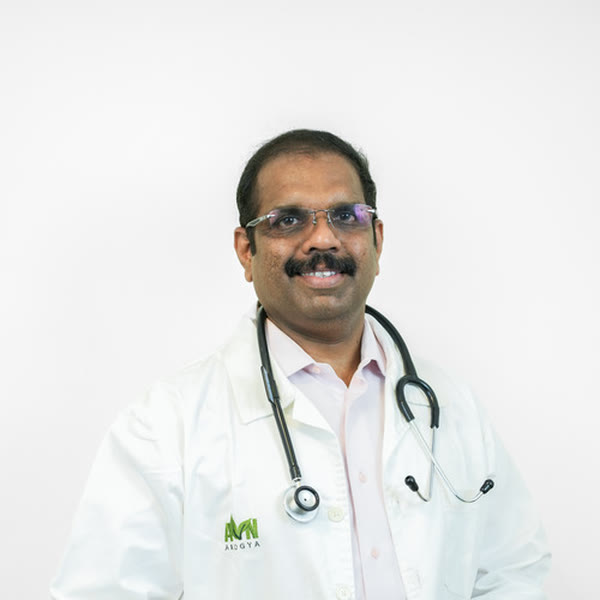
Dr.Biju Madhavan
Chief Consultant Physician
BAMS, MD (Ayurveda)
Dr. Ramesh R. Varier
Senior Consultant Physician & Managing Director
BAMS, (Gold Medalist) & Guru under RAV, Clinical Hypnotherapist
Dr. Chippi
Senior - Physician
BAMS.,
Dr. Geethu Sajan
Senior Physician & Clinic-In-Charge
BAMS
Dr. Padmavathy
Senior Physician & Clinic-in-Charge
BAMS
Dr. Jyothish Bharatan
Senior Physician & Clinic-in-Charge
BAMS
Avascular Necrosis — Overview & Ayurvedic Understanding
Avascular necrosis of the femoral head is a devastating diagnosis — blood supply to the hip bone is disrupted and without timely intervention the joint collapses. Our 96+ year legacy in Ayurvedic AVN care combines intensive Panchakarma, targeted internal medicines to restore bone vascularity, and structured physiotherapy. We have a dedicated AVN clinical pathway that has helped thousands avoid hip replacement.We also treat avascular necrosis of the knee, of the shoulder, and other minor joints like the wrists and the feet etc though they are relatively rare.
Symptoms of Avascular Necrosis
The most common site for Avascular Necrosis is the hip. AVN of the hip manifests as hip or groin pain, initially with activity only
Night pain as the condition progresses
Limp or altered gait
Restricted hip rotation (especially internal rotation)
Referred pain to the knee
Functional decline — difficulty climbing stairs, squatting
Causes & Risk Factors for Avascular Necrosis
Long-term steroid use (most common in India)
Excessive alcohol consumption
Trauma or hip dislocation
Radiation or chemotherapy
Sickle cell disease and coagulation disorders
Idiopathic (in roughly 20% of cases)
How We Diagnose Avascular Necrosis
Review of pelvis X-ray and hip MRI — MRI is the gold standard for early AVN. Based on the MRI findings the disease is staged into different stages based on different methods. Most common is Ficat-Arlet staging (Grade 1-4). In addition a battery of blood tests like ( ESR, CRP, Lipid Profile, Blood coagulation studies, Homocysteine, and general health markers like HbA1c, Liver and Renal markers, CBC and Vitamin D3 and B12 are done to evaluate potential causative and contributory factors so as address them holistically. Harris Hip Score and VAS (Visual analogue Scale) pain score and QOL (Quality of LIfe) questionnaire are used by us to grade the intensity of impact of the condition before and after treatment.
Avascular Necrosis — Surgery vs Non-Surgical Ayurvedic Treatment
Why Non-Surgical Ayurvedic Treatment Works for Avascular Necrosis
Grade 1-4 AVN responds strongly to our intensive 21-day inpatient programme — >95% of Grade 1-2 patients halt progression, Rare cases of Grade 1 & 2 Patient have even shown complete reversal, >90% of Grade 3 patients are able to avoid surgery and recover functionally fully and see non-progression of the stage in 1 year post treatment MRIs. Even many Grade 4 patients get significant functional improvement and meaningful pain relief and are able to function without replacement surgery.
When Surgery Is the Right Path
Grade 4 AVN with severe pain and functional disability including inability to walk and carry out activities of daily life, despite full course of treatment and good compliance to protocol usually requires hip replacement. Patients who are healthy and aged above 70 are also good candidates for replacement surgery if they can afford it. We clearly recommend patients who may need surgery to go for surgery.
We maintain transparent referral relationships with leading orthopaedic and specialist surgeons.
Key Outcomes
>95% of Grade 1-2 AVN patients halt progression, significant functional recovery and pain improvement. Rare cases have shown complete reversal.
>90% of Grade 3 patients show significant functional improvement and pain relief and are able to avoid hip replacement without further progress in stage.
Meaningful pain reduction within 10-14 days of admission for most patients
Treatment Pathways for Avascular Necrosis
Outpatient (OP)
The start of the treatment process for AVN is a consultation. Where the doctor looks at the entire details and decides the suitability of our treatment for that particular patient and tentative time frame, whether 21 days are enough or whether some extension may be required. The first course of treatment is invariably an inpatient treatment of 21 days, following which there will be follow-up review consultations at the OP and recommendations for medicines, supplements, exercises, diet, lifestyle, etc. on an ongoing basis.
Book OP Appointment →Inpatient Program
Intensive residential treatment with daily Panchakarma, physiotherapy, yoga, and dietary management.
Typical duration: 21-28 days
Learn About IP Care →Ayurvedic Treatment Approach for Avascular Necrosis
The approach to treatment of AVN comprises of addressing the root causes that are ascertained through a thorough history and diagnostic tests. After that, we attempt to address the underlying issues sequentially. Our 96-year AVN practice has shown clearly that no two cases of Avascular Necrosis respond the same way.
The grade, location, inflammatory state, and patient factors all shape a programme that is individual to each patient. At AVN Arogya, there is no fixed protocol. Every patient's programme is designed personally by the treating physician based on the specific stage of the disease, the current inflammatory state, the dosha vitiation pattern, constitutional type (Prakriti), and individual response to treatment.
This physician-crafted approach — refined across four generations of AVN clinical practice — is what makes our care genuinely personalised rather than packaged. However the treatment generally comprises of procedures to help reduce inflammation, improve blood flow to the region, improve bone strength by promoting bone metabolism and addressing all posssible factors that interfere with the natural healing process of the body. Medicines, herbal combinations, and internal formulations are equally individualised: what works for one patient's presentation will not necessarily suit another's. Your programme will draw on the full range of classical Ayurvedic tools — Panchakarma (the five purification procedures), Kerala therapies, Upakarma (supportive procedures), Physiotherapy, Yoga if needed along with dIet and lifestyle modifications.
Ayurvedic Therapies for Avascular Necrosis
These are examples of classical Ayurvedic therapies that may be selected for your programme depending on your condition, stage, and constitutional type. Your treating physician decides which therapies are appropriate — no two programmes are the same.
Bandhanam
AdjunctiveA therapeutic herbal immobilization wrap used to stabilize weak or injured joints and accelerate deep ligament healing.
Learn about this therapy →
Lepanam
AdjunctiveAn application of a thick, targeted herbal paste over specific body areas to quickly draw out inflammation, pain, or skin impurities.
Learn about this therapy →
Navarakizhi
Kerala TherapyTherapeutic massage with boluses of cooked medicinal rice in warm medicated milk — one of the most restorative Kerala therapies.
Learn about this therapy →
Elakizhi
Kerala TherapyTherapeutic massage with boluses of fresh medicinal leaves warmed in medicated oil — excellent for inflammatory-painful joint conditions.
Learn about this therapy →
Ajavit kizhi
Kerala TherapyA specialized, traditional dry bolus therapy designed to relieve severe sciatic pain and deep nerve compression.
Learn about this therapy →
Tailadhara
Kerala TherapyA luxurious, highly therapeutic continuous pouring of warm medicated oils to nourish nerves, soothe anxiety, and deeply hydrate tissues.
Learn about this therapy →
Kadidhara
Kerala TherapyA continuous, rhythmic pouring of warm, fermented herbal grain liquid to combat deep-seated inflammation, fluid retention, and stiffness.
Learn about this therapy →
Erikkila kizhi
Kerala TherapyA targeted leaf-poultice massage leveraging the intense anti-arthritic power of Calotropis to dissolve severe heel and joint pain.
Learn about this therapy →
Manjal kizhi
Kerala TherapyAn anti-inflammatory, warming bolus massage utilizing fresh turmeric to accelerate tissue healing and minimize localized swelling.
Learn about this therapy →
Your physician may also include Podi kizhi, Vasti, Swedanam or Udwarthanam, depending on your presentation.
Treatment Outcomes for Avascular Necrosis
Grade 1-3 AVN patients typically see significant pain reduction within the course at the hospital and meaningful improvement in joint function, walking and activities of daily living within 3-6 months.
Prevention of progression is seen in over 95% of cases on follow-up MRI.
Rarely we have also seen complete reversal on repeat MRIs.
Most patients avoid joint replacement surgery entirely. Even Grade 4 patients see significant pain relief and tangible improvement in functional capacity and are able to postpone surgery for many years with continuous care.
Outcomes documented across 1,000+ patients treated over the past 8-9 years.
How the Treatment Works
Step 1
Assessment & Grading
Day 1 of admission
Comprehensive evaluation to confirm the grade and plan the right pathway.
- •Nadi Pariksha and Ashtavidha Pariksha by senior physician
- •Review of MRI / X-ray reports
- •Harris Hip Score and pain assessment (VAS)
- •Prakriti and Vikriti assessment
Step 2
Intensive Ayurvedic Protocol
Days 2-21
21-day inpatient programme with daily therapies and individualised medicines.
- •Abhyanga + Kati Vasti daily for targeted oil pooling at the hip
- •Panchakarma procedures (Vasti, Nasya as indicated)
- •Internal medicines: Guggulu formulations, Ashwagandha-based Rasayana
- •Structured physiotherapy and yoga therapy
- •Therapeutic diet designed by in-house dietician
Step 3
Structured Follow-up
3-12 months post-IP
Continuity of care through home medicines, teleconsults, and periodic reviews.
- •3-month home medicine protocol with personalised dosage
- •Monthly teleconsultation with your treating physician
- •Repeat imaging at 6 months to objectively track progress
- •Optional 7-day annual booster IP programme
Why AVN Arogya for Avascular Necrosis
96+ Years of AVN Expertise
Four generations of physicians at AVN Arogya have specialised in joint-preservation Ayurveda. AVN is among the few centres in India with a dedicated AVN clinical pathway.
NABH-Accredited Inpatient Care
100-bed hospital with NABH accreditation — the same clinical governance standards expected of leading modern hospitals.
Surgery-Respectful Approach
We prioritise joint preservation in Grade 1-3 and refer to top orthopaedic surgeons when surgery is genuinely the right path. Complete transparency throughout.
Cashless Insurance for IP
Empanelled with 35+ insurance providers and TPAs. Your 21-day inpatient programme can be cashless under most major health insurance plans.
Recovery Timeline
Day 1-3
Initial assessment, baseline scoring, first Abhyanga + Kati Vasti sessions. Many patients report their first meaningful rest without pain by Day 3.
Week 1-2
Full Panchakarma protocol in flow. Noticeable reduction in pain intensity (VAS) and improved hip mobility. Medicine regimen calibrated.
Week 3 (Discharge)
End-of-IP assessment. Personalised 3-month home protocol prescribed. Most Grade 1-2 patients discharge with ≥50% pain reduction.
Month 2-3
Home medicines and prescribed exercises sustain improvement. First teleconsultation review. Any concerns addressed remotely.
Month 6
Objective review with repeat imaging. For Grade 1-2 patients, many show arrested progression; Grade 3 patients show pain and function improvement.
Annual Booster
Optional 7-day booster admission each year to maintain gains, refresh therapies, and review long-term protocol.
Avascular Necrosis Treatment Cost & Programme Pricing
Inpatient treatment is INR 6,000-19,000 per day, all inclusive, depending on the room category chosen. The programme is usually 21 days, occasionally extended to 28 days in rare cases. Cashless insurance accepted through 35+ empaneled TPAs. Financing options through EMIs also available.
For condition-specific programme costs with all pathways (OPD, Visiting Therapy, Inpatient) and room-category breakdowns, open any condition above. For accommodation details and room pricing, see our inpatient rooms.
Why Choose AVN Arogya for Avascular Necrosis?
Treatment led by Dr. Ramesh R. Varier — a recognised authority in non-surgical AVN care with 35+ years of clinical experience.
Comprehensive root cause analysis and integrated treatment addressing the root causes resulting in remarkable recovery in thousands of cases.
Transparent & Honest guidance when surgery is the better path.
Radiological expert opinion and functional evaluation before treatment and 1 year after treatment to assess arrest of progression in all cases and possible reversal in earlier grades.
Follow up tele-consultations and comprehensive maintenance support provided.
And why AVN Arogya at all
- Trust built on four generations and over 96 years of Ayurveda-based healing, evidenced by the patients we have treated and the testimonials they have given.
- Tamil Nadu's first Ayurvedic hospital to be NABH accredited — a testimony to our commitment to the quality of patient care.
- Doctors who give you a patient hearing, assess in detail using both modern diagnostics and holistic Ayurvedic methods, and make honest recommendations with options to suit your condition.
- Treatment protocols personalised to your situation, including the mode of treatment that fits it — outpatient, day care or inpatient.
- A holistic approach spanning diet, lifestyle, psychological support, pure Ayurvedic medicines and external applications, Panchakarma, Upakarma and Kerala speciality therapies, physiotherapy, rehabilitation and yoga where applicable.
- Safe and effective Ayurvedic medicines manufactured in-house and tested to international standards for heavy metals.
- Cashless inpatient treatment through tie-ups with 35 insurance companies and TPAs.
- Interest-free EMI on inpatient treatment, over 3 to 18 months, through our financing partners.
- Corporate tie-ups for screening camps, teleconsultations and inpatient treatment funded by corporate health programmes or insurance.
NABH accreditation covers the Vilachery hospital in Madurai. Cashless cover applies to inpatient treatment at the Vilachery hospital.
Patient Success Stories for Avascular Necrosis
Real outcomes from real patients — watch their recovery journeys.
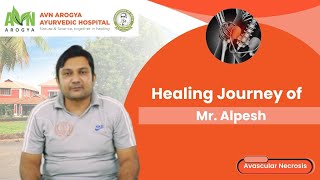
Alpesh, Rajkot
Avascular Necrosis - Stage 3
Mr. Alpesh, from Rajkot, was treated at AVN Arogya for Stage 3 avascular necrosis (AVN) and recovered without surgery. He describes the care as fully Ayurvedic and says he can now carry out his daily routine and work easily with no problems. He strongly urges others to visit AVN before opting for an operation. The video is presented as an AVN Stage 3 recovery achieved without surgery.
Surgery Avoided
Venkata Ramesh Babu
Avascular Necrosis of the right hip (steroid-induced, ~30% damage)
Mr. Venkata Ramesh Babu developed avascular necrosis of the right hip - around 30% femoral-head damage - which he attributes to steroid use that reduced blood circulation to the bone. Not wanting to replace his natural joint, he searched for an alternative to surgery and came to AVN Arogya in March 2022. He was told the condition could be halted at its current stage so he could resume normal activities, and with Ayurvedic therapy and physiotherapy he improved week by week - relief after one week and confidence in his recovery by the third.
Surgery Avoided
Ramkumar, Vishakapatnam
Avascular Necrosis of the hip
Meet Mr. Ramkumar Reddy from Vishakapatnam, who suffered from Avascular Necrosis (AVN) in his right hip. The video reports treatment at AVN Arogya (Madurai) with Ayurvedic care (Panchakarma and herbal medicines) and a positive recovery. (Based on the video description.)
Surgery Avoided
Narayana, Palani
AVN
Narayana, from Palani, is featured in an AVN Arogya patient testimonial for AVN. The video reports treatment at AVN Arogya (Madurai) with Ayurvedic care (Panchakarma and herbal medicines) and a positive recovery. (Based on the video description; condition-level summary — enrich later if verbatim detail is needed.)
Surgery Avoided
Ramesh, Andhra Pradesh
Avascular Necrosis of the hip
Mr. Ramesh from Andhra Pradesh was diagnosed with avascular necrosis of the hip and told surgery seemed the only option. Unwilling to have surgery, he came to AVN Arogya for a non-surgical plan of Kerala-based Panchakarma therapies and herbal medicines. According to the video he now walks with confidence, free from chronic hip pain - without surgery. (Based on the video description.)
Surgery Avoided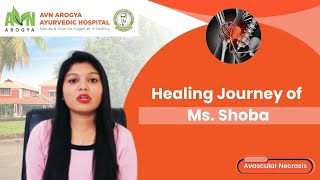
Shoba, Gujarat
Avascular Necrosis of the hip
Ms. Shoba from Gujarat had hip pain from avascular necrosis and was initially advised surgery. Seeking a surgery-free solution, she came to AVN Arogya for a personalised Kerala Ayurvedic plan including Panchakarma therapies and herbal medication. According to the video her pain reduced, her mobility improved and surgery was completely avoided. (Based on the video description.)
Surgery AvoidedHave a Question About Avascular Necrosis?
Tell us about your condition or ask anything about how we treat Avascular Necrosis. Leave your details and our team will get back to you.
Start Your Avascular Necrosis Treatment
Book a consultation to assess your condition and get a personalised treatment plan.
Ayurvedic & Medical Terms for Avascular Necrosis
View Full Glossary →Panchakarma
The five classical detoxification procedures of Ayurveda: Vamana (emesis), Virechana (purgation), Vasti (enema), Nasya (nasal), and Raktamokshana (bloodletting). The cornerstone of Ayurvedic therapeutics.
Avascular Necrosis
Death of bone tissue due to interrupted blood supply, most commonly affecting the hip joint. AVN Arogya's flagship speciality.
Dosha
The three fundamental bio-energies that govern all physiological and psychological functions: Vata (movement), Pitta (metabolism), and Kapha (structure). Disease arises from their imbalance.
Inflammation
The body's immune response to injury or infection, characterised by redness, swelling, heat, and pain. Chronic inflammation plays a central part in many autoimmune and degenerative conditions.
Joint Replacement
Surgical replacement of a damaged joint with an artificial implant. AVN Arogya's protocols aim to help patients avoid this.
MRI
Magnetic Resonance Imaging -- a scan that uses strong magnets and radio waves to create detailed pictures of bones, joints, and soft tissues without radiation. It is the primary diagnostic tool for conditions like AVN and disc prolapse.
Necrosis
Death of body tissue caused by loss of blood supply, injury or disease.
Physiotherapy
A healthcare discipline that uses physical methods -- exercises, manual therapy, and electrotherapy -- to restore movement and function. At AVN Arogya, physiotherapy is integrated with Ayurvedic treatment for comprehensive rehabilitation.
Prakriti
An individual's unique constitutional type determined at birth by the predominance of doshas. Understanding Prakriti guides personalised treatment, diet, and lifestyle recommendations.