

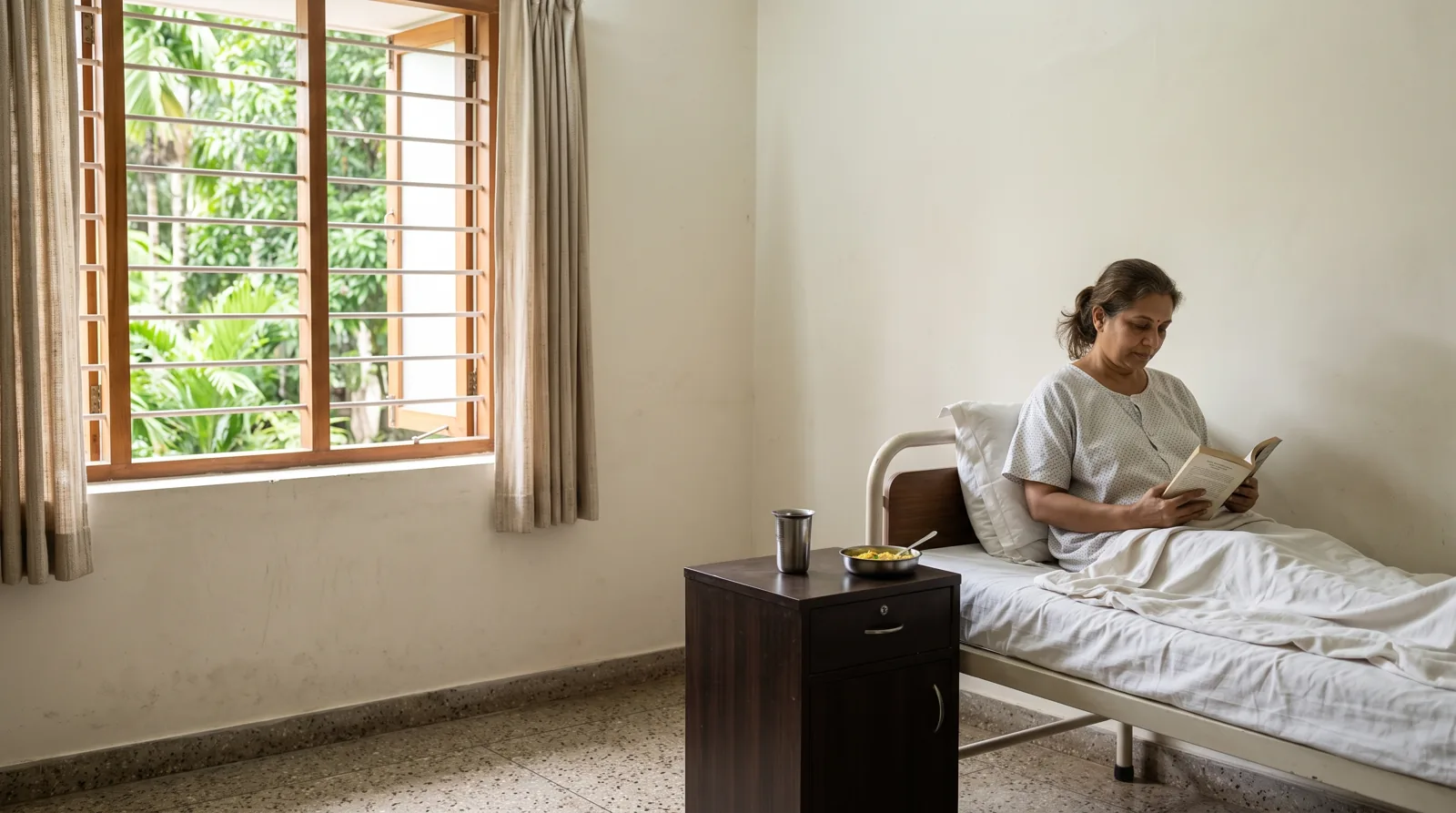
Time away from home and work is a real decision, and it helps to know exactly what you are choosing. A Panchakarma stay at AVN Arogya is an inpatient programme at our NABH-accredited Madurai hospital, usually 14 days for a full course, with the length set by your physician. Each day brings physician rounds, Ayurvedic therapies, a prescribed diet and round-the-clock nursing care. It is time given wholly to healing, which is why our structured inpatient programmes deliver the most effective Ayurvedic outcomes.
How many days does a Panchakarma stay take?
There is no fixed package. Your physician decides the duration from your condition, its severity and how you respond to treatment. The programmes described on our inpatient page are:
- Short course — Typical length: 3–5 days, often repeated; Usually for: Maintenance courses, autoimmune flare prevention
- One-week programme — Typical length: 7 days; Usually for: An introductory course, or a follow-up after a longer programme
- Standard programme — Typical length: 14 days; Usually for: The most common length for musculoskeletal conditions, such as disc prolapse, sciatica, frozen shoulder and knee osteoarthritis
- Intensive programme — Typical length: 14–21 days; Usually for: Bone and autoimmune conditions with structural involvement
- Extended rehabilitation — Typical length: 28–45 days, up to 60; Usually for: Severe neurological and complex conditions
Fourteen days is the minimum duration for a full Panchakarma course. These durations are indicative: some people recover faster and some benefit from longer, and we never extend a stay beyond what is clinically necessary.
Why it takes this much time
The body heals on its own timetable, and Panchakarma works with it rather than against it. It has three stages, and none can be rushed. Preparation usually takes 3 to 7 days of oil and sweating (sudation) therapies. The main procedures follow over the next 1 to 7 days. After that comes a graduated return to normal food and routine.
A programme of 14 to 21 days allows enough time for deep cleansing, for the medicines and therapies to take full effect, and for improvement you can measure. If you are worried about time away, say so at your consultation; your physician will explain why a particular length has been advised.
What happens each day during a Panchakarma stay?
Your timetable is drawn up for you, so no two patients' days are the same. What every day has in common:
- Physician rounds. Your doctors see you through every stage of your stay.
- Therapies, tailor made for your condition by a physician. Treatment is given daily by trained therapists. You will have one or two sessions of therapy, as prescribed by your doctor.
- Nursing care around the clock, with your medicines given in your room by trained nursing staff.
- Meals prescribed by your doctor, served in your room.
- Physiotherapy and yoga, where they are part of your plan.
- Rest. Rest is part of healing, and some intensive Panchakarma days are best kept free of work.
What each stage of Panchakarma feels like
Preparation days. You may be given Snehapana: warm medicated ghee or oil taken on an empty stomach in gradually increasing amounts. It is normal to have less appetite, a heavy stomach and ghee-flavoured burps for a while. Oil massage (Abhyangam) and herbal steam (Swedanam) are often part of these days.
Main procedure days. If Vamanam (therapeutic emesis) or Virechanam (therapeutic purgation) is prescribed, it is usually carried out in the inpatient unit. For Vamanam, you are monitored closely before, during and after. After a Vasti (medicated enema), you rest for 15 to 30 minutes.
Recovery days. Food and routine are brought back to normal step by step. By the end, expect to feel lighter and sleep better, and to see measurable improvement in what you came for.
Can I keep working while I stay?
Often, yes. Every room and villa has high-speed Wi-Fi and space for a laptop, and where it is clinically appropriate, therapy timings can be planned around important calls. Your physician will tell you how much activity suits your condition.
What will I eat during Panchakarma?
Your diet is prescribed by your doctor and individualised to your condition and your treatment, and it is prepared in our therapeutic kitchen. It changes as you move through the stages: after the main procedures, food is reintroduced gradually rather than all at once.
What does a Panchakarma stay cost?
Cost has two parts: treatment and accommodation. Treatment (therapies, medicines, physician visits and nursing) depends on the programme your physician recommends and how long it runs. Accommodation is priced separately, so you can choose your comfort level. All rooms are private, with an attendant bed and free Wi-Fi.
- Economy Room — Room tariff per day: ₹1,250; Treatment + stay, approximate per day: ₹6,000–7,000
- Executive Room — Room tariff per day: ₹2,750; Treatment + stay, approximate per day: ₹8,000–9,000
- Deluxe Room — Room tariff per day: ₹3,300; Treatment + stay, approximate per day: ₹8,500–9,500
- Classic Villa — Room tariff per day: ₹4,950; Treatment + stay, approximate per day: ₹13,000–14,000
- Deluxe Villa — Room tariff per day: ₹6,600; Treatment + stay, approximate per day: ₹14,500–15,500
- Royal Villa — Room tariff per day: ₹9,900; Treatment + stay, approximate per day: ₹18,000–19,000
The treatment-plus-stay figures are indicative and include room, doctors' visits, nursing, food, Ayurvedic therapies and oral medicines. Yoga, physiotherapy, investigations (tests), laundry and discharge medicines are billed separately. Because the final cost depends on your condition, you get a full breakdown (clinical charges, room and expected insurance co-pay) before you commit.
Insurance and EMI
Our Madurai hospital is NABH-accredited and empanelled with 35+ insurance companies and TPAs, so inpatient treatment can be cashless or reimbursed, subject to your policy. Room eligibility depends on your sum insured and room-rent limit, and our insurance desk checks this before admission. If you prefer to self-pay, interest-free EMI over 3 to 18 months is available through financing partners; the lender charges its own processing fee.
How your Panchakarma stay begins at AVN Arogya
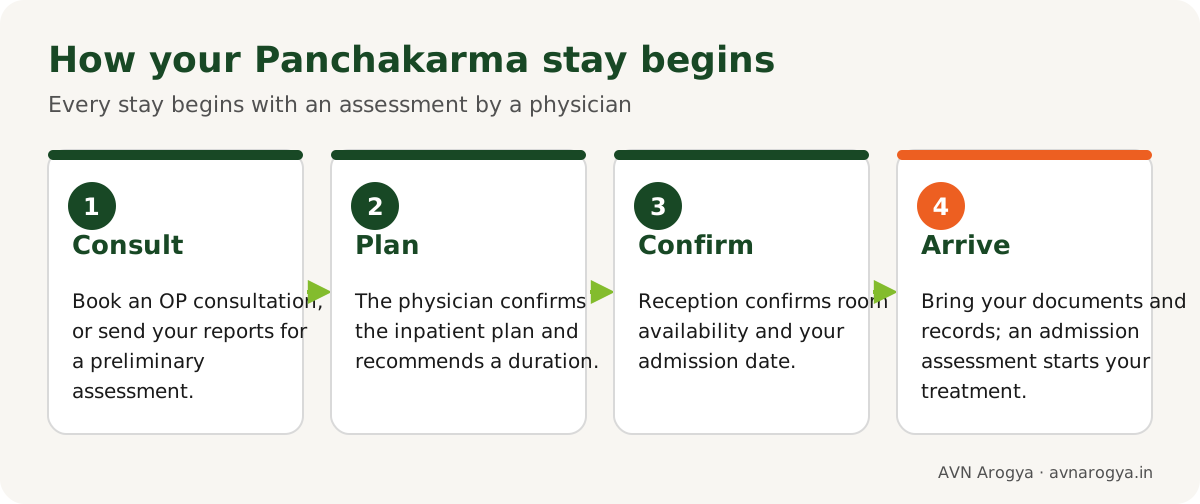
Every stay begins with an assessment by a physician. An outpatient consultation assesses your condition and advises you; it is not itself treatment. Admission then follows five steps:
- Book an OP consultation, or send your reports for a preliminary assessment.
- The physician confirms the inpatient plan and recommends a duration.
- Reception confirms room availability and your admission date.
- You arrive with your documents and medical records.
- An admission assessment and baseline vitals are taken, and treatment begins.
What to bring: a government ID, all previous medical records and scans, a list of your current medicines, loose cotton clothing, toiletries, insurance details if you have them, and an emergency contact. Do not stop any prescribed medicine before admission; your physician will plan around it.
Frequently asked questions
How many days is Panchakarma treatment?
It depends on your condition. A full course takes at least 14 days; shorter 3–5 day and 7-day courses are used for maintenance or follow-up.
Can I do Panchakarma in 7 days?
A 7-day introductory programme exists for milder conditions or as a follow-up course. Whether it is enough for you is your physician's decision after assessment.
Is Panchakarma covered by insurance?
Inpatient treatment at our NABH-accredited Madurai hospital can be cashless or reimbursed, depending on your policy terms.
Can a family member stay with me?
Yes. Every room has an attendant bed, the larger villas have family space, and our IP coordinator can arrange family accommodation and airport pickup for outstation patients.
Can I leave early or extend my stay?
Your physician reviews your progress during the stay and sets the duration from your response. A stay is never extended beyond what is clinically necessary.
A Panchakarma stay is an investment in your own healing, and we will help you plan it properly. See inpatient care at AVN Arogya for programmes, rooms and insurance, or book a consultation to get a plan and cost estimate for your condition. You can send your reports in advance.