


Your knee has hurt for weeks, worse at night and worse with every step, and the MRI now says avascular necrosis (AVN) — also called osteonecrosis — of the knee. Perhaps you have been told it will end in a knee replacement. It does not have to, especially when it is found early. Knee AVN is less common than hip AVN, but it responds to the same careful approach: find the cause, calm the inflammation, restore blood flow and protect the bone while the body heals. AVN is our flagship speciality at AVN Arogya.
What is avascular necrosis of the knee?
AVN of the knee happens when the blood supply to part of a knee bone is interrupted, so that the bone weakens and may collapse. It usually affects the rounded ends of the thighbone (the femoral condyles) and sometimes the top of the shinbone (the tibial plateau).
There are two main kinds:
- Secondary (or steroid-related) osteonecrosis. Usually in people under 55, often linked to steroids, alcohol or another illness; it may affect both knees and other joints such as the hips.
- Spontaneous osteonecrosis of the knee (SONK). Usually in people over 55, more often women, with sudden pain on the inner side of the knee, often with no clear cause.
Symptoms of AVN of the knee
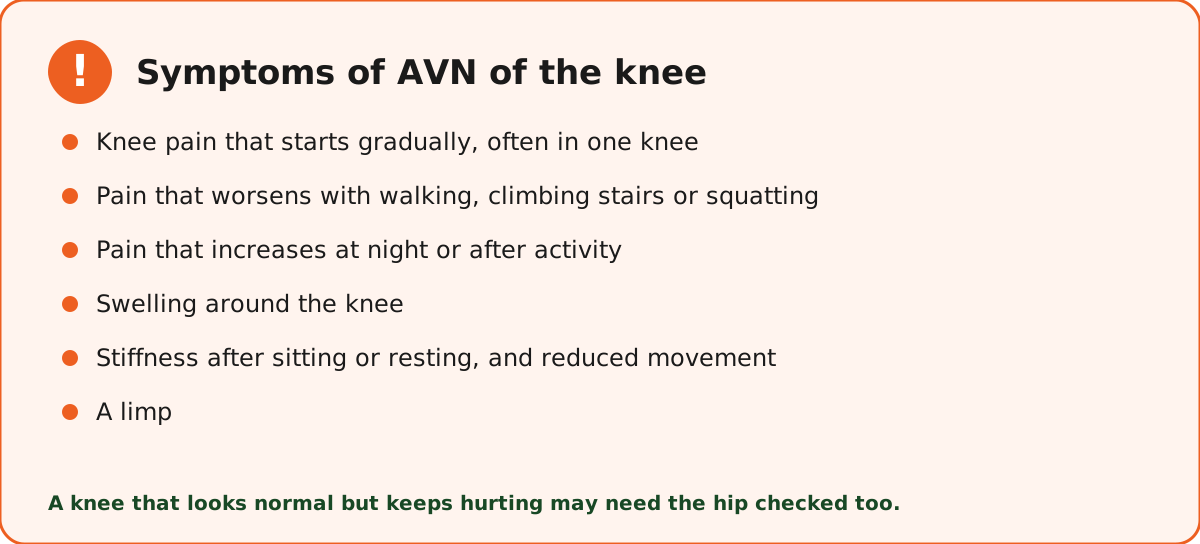
- knee pain that starts gradually, often in one knee
- pain that worsens with weight-bearing, walking, climbing stairs or squatting
- pain that increases at night or after activity
- swelling around the knee
- stiffness, especially after sitting or resting, and reduced movement
- a limp
Knee pain can also come from the hip: AVN of the hip can cause referred pain in the knee while the knee itself is normal. If your knee looks normal but keeps hurting, your hip may need checking too. See the early signs of AVN of the hip.
What causes AVN of the knee?
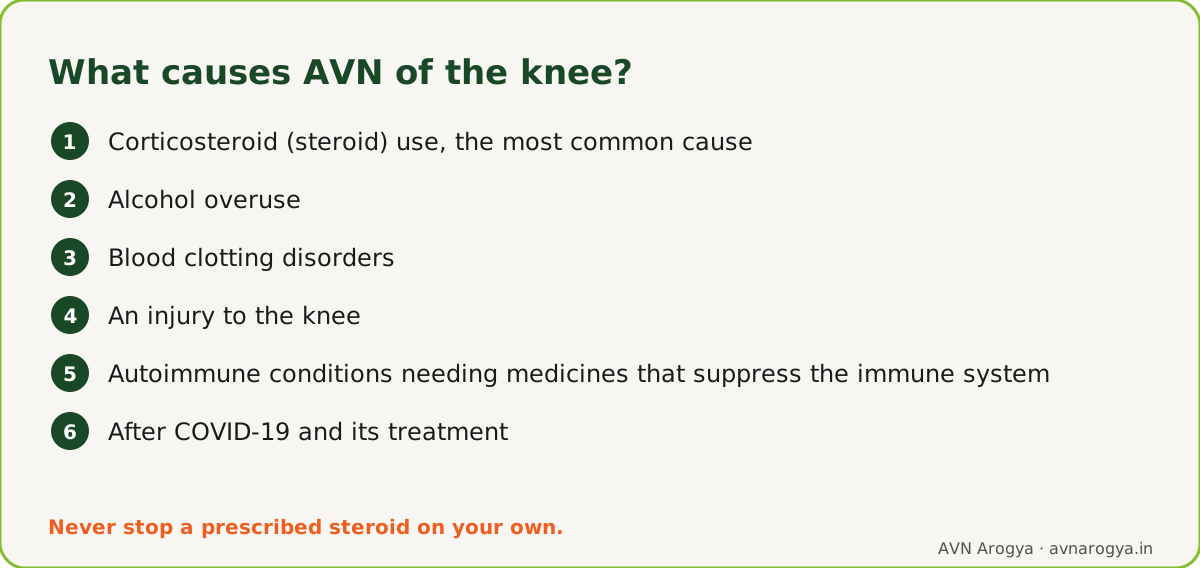
The causes are similar to those of hip AVN:
- corticosteroid (steroid) use — the most common cause
- alcohol overuse
- blood clotting disorders
- an injury to the knee
- autoimmune conditions needing medicines that suppress the immune system
- after COVID-19 and its treatment
Sometimes no cause is found. If you take steroids for another illness, never stop them on your own; our physicians coordinate with the doctor who prescribed them. Read Can steroids cause avascular necrosis?
How AVN of the knee is diagnosed
MRI of the knee is the gold standard: it finds AVN before any change shows on an X-ray. X-rays (front and side views) show later changes, and blood tests — including a lipid profile, clotting studies and inflammatory markers — help find the cause.
AVN of the knee is not the same as knee osteoarthritis, although both cause knee pain. In osteoarthritis the cartilage wears gradually; in AVN the bone beneath it loses its blood supply. If you have been told you have knee arthritis, read Is osteoarthritis curable? The four stages of knee OA.
Ayurvedic treatment for AVN of the knee at AVN Arogya
The body has a strong capacity to heal, and Ayurveda strengthens it with medicines and therapies that work differently from modern drugs. Our treatment for AVN works to reduce inflammation, improve blood flow to the bone, strengthen the bone by supporting bone metabolism, and remove what gets in the way of the body's own healing.
It starts with a consultation. Your physician reviews your history and reports, decides whether our treatment suits you, and gives a tentative time frame.
The first course is an inpatient programme, usually 21 days, followed by outpatient reviews with medicines, exercises, diet and lifestyle advice on an ongoing basis.
Every programme is personal. Senior physicians plan it for where the AVN is in the knee, the risk of collapse, how inflamed the knee is and how well you can move; no two programmes are the same. It brings together:
- our own Ayurvedic medicines, made in-house and tested to international standards for heavy metals
- classical therapies chosen for you, which may include Kerala therapies such as Kizhis like Podikkizhi, Elakizhi and Ajavitkizhi (boluses of herbal powders, fresh medicinal leaves and herbs warmed on a tawal), herbal applications such as Lepanam and Upanaham, and Janu Vasti, where warm medicated oil is held over the knee
- Vasti, the medicated enema of Panchakarma, when your physician judges it suitable
- Navarakizhi (massage with boluses of medicinal rice cooked in medicated milk)
- physiotherapy, including isometric strengthening of the thigh muscles, and clinical yoga therapy for alignment of the leg
- a therapeutic diet
What you can expect
Patients usually feel the pain ease first, then walking and daily activity improve over the following months. Early detection by MRI and prompt treatment can halt the progression of knee AVN without the need for knee replacement. In many of the patients we treat for early knee AVN, the pain settles and the knee is preserved. Progress is checked with a repeat MRI.
When knee replacement is the right path
Knee replacement may be needed for stage 4 knee AVN with advanced collapse and arthritis. We give an honest assessment and refer you to orthopaedic specialists when surgery is the better option.
Frequently asked questions
Can AVN of the knee heal without surgery?
When it is found early, often yes: early detection by MRI and prompt treatment can halt progression without a knee replacement. Whether our treatment suits you is decided at consultation, after your physician has seen your MRI.
Is AVN of the knee the same as hip AVN?
It is the same disease in a different bone. The causes are similar, and people with knee AVN, especially after steroids, can have AVN in other joints too. If your hips also ache, mention it at consultation; we can assess AVN at any joint.
Can I walk with AVN of the knee?
Your physician will advise how much weight the knee can take at your stage; a walking aid for a period can protect the bone while it heals. Avoid squatting, kneeling and climbing many stairs until advised.
Does insurance cover treatment for knee AVN?
Inpatient treatment at our Vilachery hospital in Madurai can be cashless through more than 35 insurance companies and TPAs, with interest-free EMI available.
Seek urgent care if your knee suddenly becomes very painful and swollen, if you cannot put weight on the leg, or if the knee is hot and red with a fever.
For an honest second opinion and a chance to avoid unnecessary surgery, consult an AVN Senior Physician and bring your MRI. Read about Ayurvedic treatment for AVN of the knee at AVN Arogya, or book a consultation — you can send your MRI and reports in advance.