


Your report says "AVN, Ficat stage 2" — or "ARCO IIIA" — and nobody has told you what that means for your hip. The stage describes how far the bone under the ball of the hip has changed. It is the most useful single fact for planning treatment, and it is a reason for hope more often than people think. At AVN Arogya, in the majority of the patients we treat for early-stage AVN, progression is arrested without surgery, and many of our patients who were told replacement was the only option have avoided or deferred it.
Why there are different systems for staging avascular necrosis
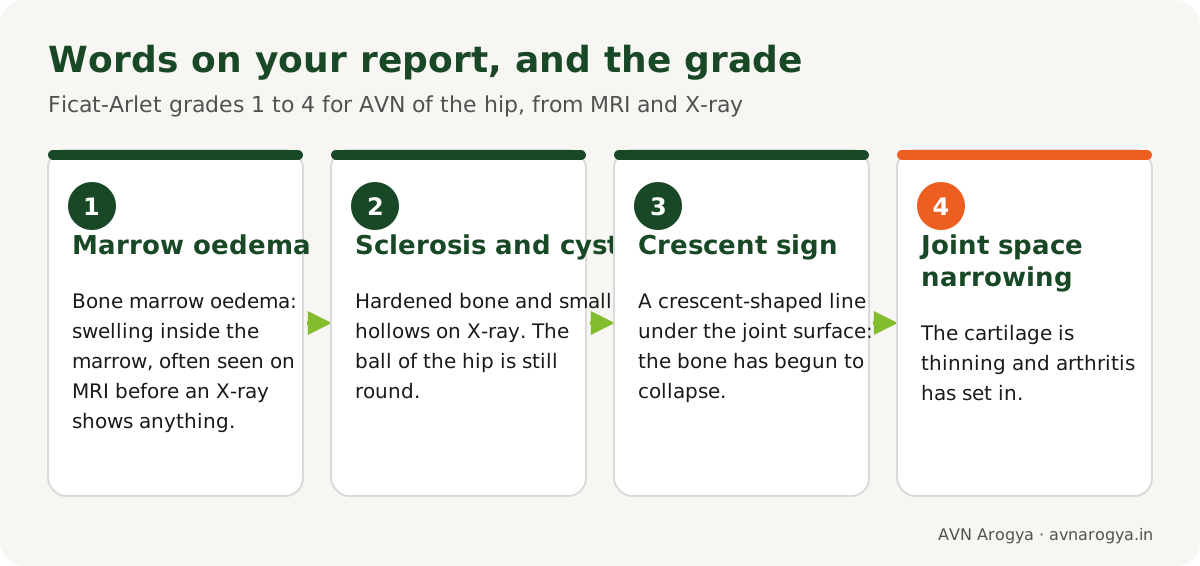
Avascular necrosis (AVN) of the hip happens when the blood supply to the ball of the thighbone (the femoral head) is interrupted and part of the bone weakens. Doctors stage it so that everyone treating you is describing the same thing.
You may see one of three systems on a report:
- Ficat-Arlet — the oldest and most widely used; it stages the hip mainly from X-ray and MRI appearance.
- ARCO (Association Research Circulation Osseous) — an international system, revised in 2019, built on MRI and X-ray.
- Steinberg (University of Pennsylvania) — also measures how large the affected area is.
At AVN Arogya we use the Ficat-Arlet grade, and we read ARCO reports alongside it. For the individual words on a scan report, such as "marrow oedema" or "double-line sign", see our guide to your hip MRI or X-ray report.
Ficat-Arlet and ARCO stages side by side
- X-ray normal; MRI shows the change — Ficat-Arlet: Stage 1; ARCO (2019): Stage I
- Visible changes (sclerosis, cysts) on X-ray; the ball still round — Ficat-Arlet: Stage 2; ARCO (2019): Stage II
- The bone under the joint surface has cracked (crescent sign); early flattening — Ficat-Arlet: Stage 3; ARCO (2019): Stage IIIA (flattening up to 2 mm)
- Clear collapse of the ball — Ficat-Arlet: Stage 3; ARCO (2019): Stage IIIB (flattening more than 2 mm)
- Flattened ball, narrowed joint space, arthritis — Ficat-Arlet: Stage 4; ARCO (2019): Stage IV
The two systems agree on the big picture. The main difference is at stage 3: ARCO splits early collapse (IIIA) from definite collapse (IIIB), which helps your doctors judge how much of the joint surface is still holding its shape. Some reports also describe the size and position of the affected area — small, medium or large, and whether it lies under the weight-bearing part of the joint. These details matter, but they are never the whole story.
What each stage of avascular necrosis means for you
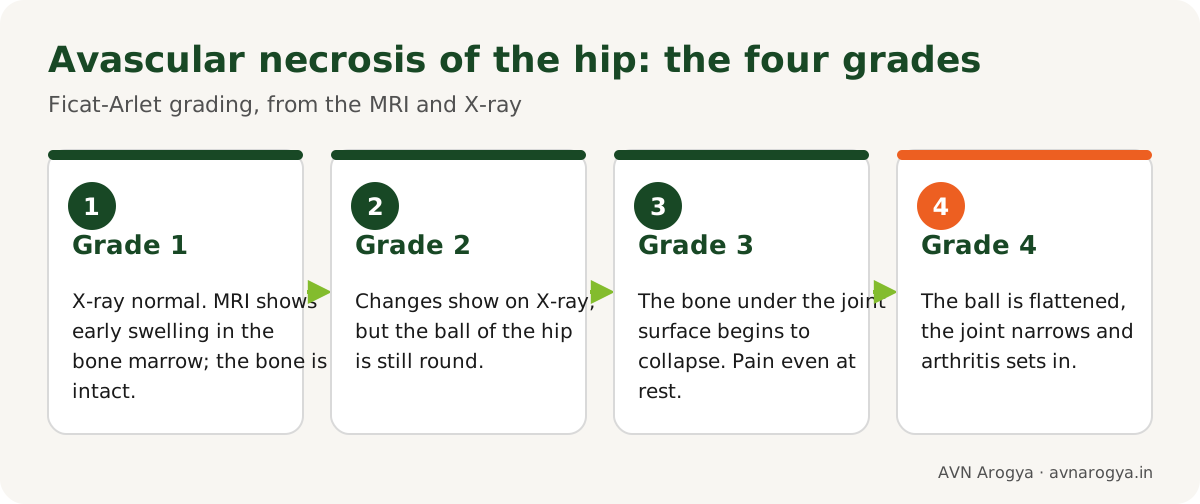
Stage 1 — the silent stage
You may feel only a mild ache after long activity, and the X-ray is usually normal; the MRI shows early swelling in the bone marrow. The bone structure is intact. This is the stage with the most room for the body to heal, and the time to act. At AVN Arogya the first course is usually an inpatient stay of 21 days and at this stage the chances of reversal are the highest.
Stage 2 — changes on X-ray, the ball still round
Pain comes with walking, the hip loses some movement and turning it inwards hurts. The X-ray now shows changes, but the ball of the hip keeps its shape. The usual first course is a structured 21-day inpatient programme. In the majority of the patients we treat at stages 1 and 2, progression is halted, with significant pain relief and recovery of function. Very rare cases of reversal are also noted.
Stage 3 — the bone beneath the surface has cracked
Pain is present even at rest, movement is clearly limited and there is a limp. The crescent sign shows that the bone just under the joint surface has begun to give way. This is the stage at which many people are told surgery is the only option. At AVN Arogya the inpatient programme is usually 21 days, followed by outpatient follow-up, and in the majority of the patients we treat at this stage, pain and function improve significantly and hip replacement is avoided, with no further progression in stage. Read more in AVN stage 3: can it be treated without surgery?
Stage 4 — collapse and arthritis
The ball is flattened, the joint space narrows and arthritis sets in, with severe pain and a marked limp. Care at this stage is through the 21 - 28 day admission based on the severity of the condition and outpatient treatment and follow-up, with shorter inpatient admissions as needed, aimed at pain relief and function, with an honest discussion about replacement. Many of our stage 4 patients still gain meaningful relief and function and have lived without a replacement for years.
What a stage does not tell you
A stage is a picture of the bone on one day. It does not show why the blood supply failed, how inflamed the hip is, or how much your body can still heal. Two people at the same stage can do very differently, depending on how early treatment starts and whether the causes — steroids, alcohol, a clotting tendency or another illness — are found and addressed.
That is why your physician at AVN Arogya looks beyond the stage: your history, a panel of blood tests, a Harris Hip Score and a pain score at the start, and how you live and work. Every programme is then designed personally for your stage, the risk of collapse, your age and your inflammatory state. The protocol is not a fixed one but tailored to your specific condition.
How we treat avascular necrosis at every stage
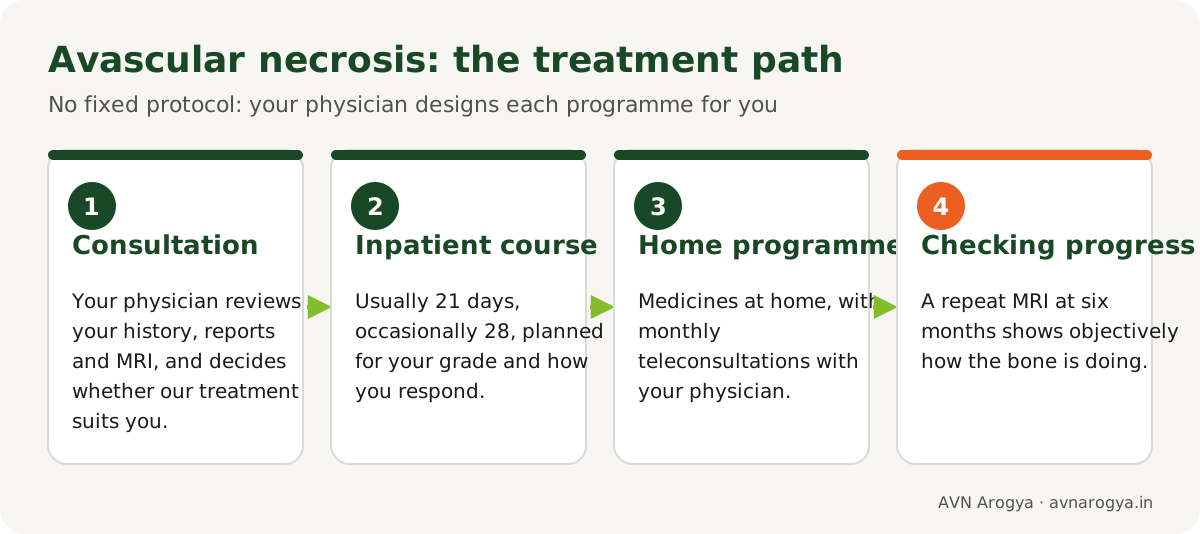
The body has a strong capacity to heal, and Ayurveda strengthens it with medicines and therapies that work differently from modern drugs. Our treatment works to reduce inflammation, improve blood flow to the bone, strengthen the bone by supporting bone metabolism and muscles, and remove what gets in the way of the body's own healing. It brings together our own Ayurvedic medicines, made in-house and tested to international standards for heavy metals; classical therapies chosen for you, such as Vasti and Kizhis; physiotherapy and yoga that protect the hip; and a therapeutic diet.
Progress is checked, not assumed: a repeat MRI at one year and an expert radiological review a year after treatment confirm whether the stage has held. We record your stage at the start so that every later scan is compared against it.
When surgery is the right step
We say this plainly. Stage 4 AVN with severe pain and disability — progressive inability to walk or manage daily life — despite a full course of in-patient treatment and about 6 months of medication and recommended exercises, and lifestyle followed faithfully, usually needs a hip replacement. When that is the right path, we recommend it clearly and refer you to orthopaedic surgeons. If you have been advised a replacement, read Told you need a hip replacement for AVN? Read this first.
Frequently asked questions
My report gives a stage on a different system. Does it matter?
Not much. Ficat-Arlet and ARCO describe the same changes in slightly different ways, and your physician can read either. If no stage is written on your report, ask the radiologist which stage it is, and on which system.
Can the stage of AVN go backwards?
The first aim of treatment is that the stage does not move forward. In the majority of the patients we treat for early-stage AVN, the follow-up MRI shows that progression has been arrested. Occasionally, in early stages, we have seen the damage reverse on a repeat MRI; we do not promise this.
How fast does AVN move from one stage to the next?
It varies from person to person. Without treatment, many hips in the early stages go on to collapse, which is why early diagnosis and early action matter so much.
Should both hips be staged?
Yes, when your physician advises it. AVN often affects both hips, sometimes before the second one hurts, so an MRI of the other hip is part of a full assessment when clinically indicated.
Seek urgent care if your hip pain suddenly becomes severe, if you suddenly cannot put weight on the leg, or if the hip is hot and swollen with a fever.
For an honest second opinion and a chance to avoid unnecessary surgery, consult an AVN Senior Physician and bring your MRI. Read about Ayurvedic treatment for avascular necrosis at AVN Arogya, or book a consultation — you can send your MRI and reports in advance.