
Being told "the bone in your hip is dying, you need a replacement" is frightening, especially when you are young. But avascular necrosis is not automatically a sentence to surgery. It is AVN Arogya's flagship speciality. Our staged programme helps to arrest the damage and preserve your natural hip, and in the majority of the patients we treat for AVN, progression is arrested. Many of our patients who were advised replacement have avoided or deferred it.
Does avascular necrosis always mean a hip replacement?
No. What decides it is the stage. Patients diagnosed in Grades 1 and 2 have the best opportunity to preserve the hip without surgery. Even in Grade 3 patients where early collapse may have begun, treatment can still relieve pain, improve function and support joint preservation. In Grade 4, with advanced collapse and arthritis, we see patients gain relief from pain and improved walking and are able to delay surgery for varying lengths of time and lead almost normal lives. However, in some cases replacement may be the most appropriate option.
The body has a powerful capacity to heal, and Ayurveda helps it. Our treatment works to reduce inflammation, improve blood flow to the hip, strengthen the bone by supporting bone metabolism, strengthen the supporting muscles to regain function and remove whatever is getting in the way of the body's natural healing.
What is avascular necrosis of the hip?
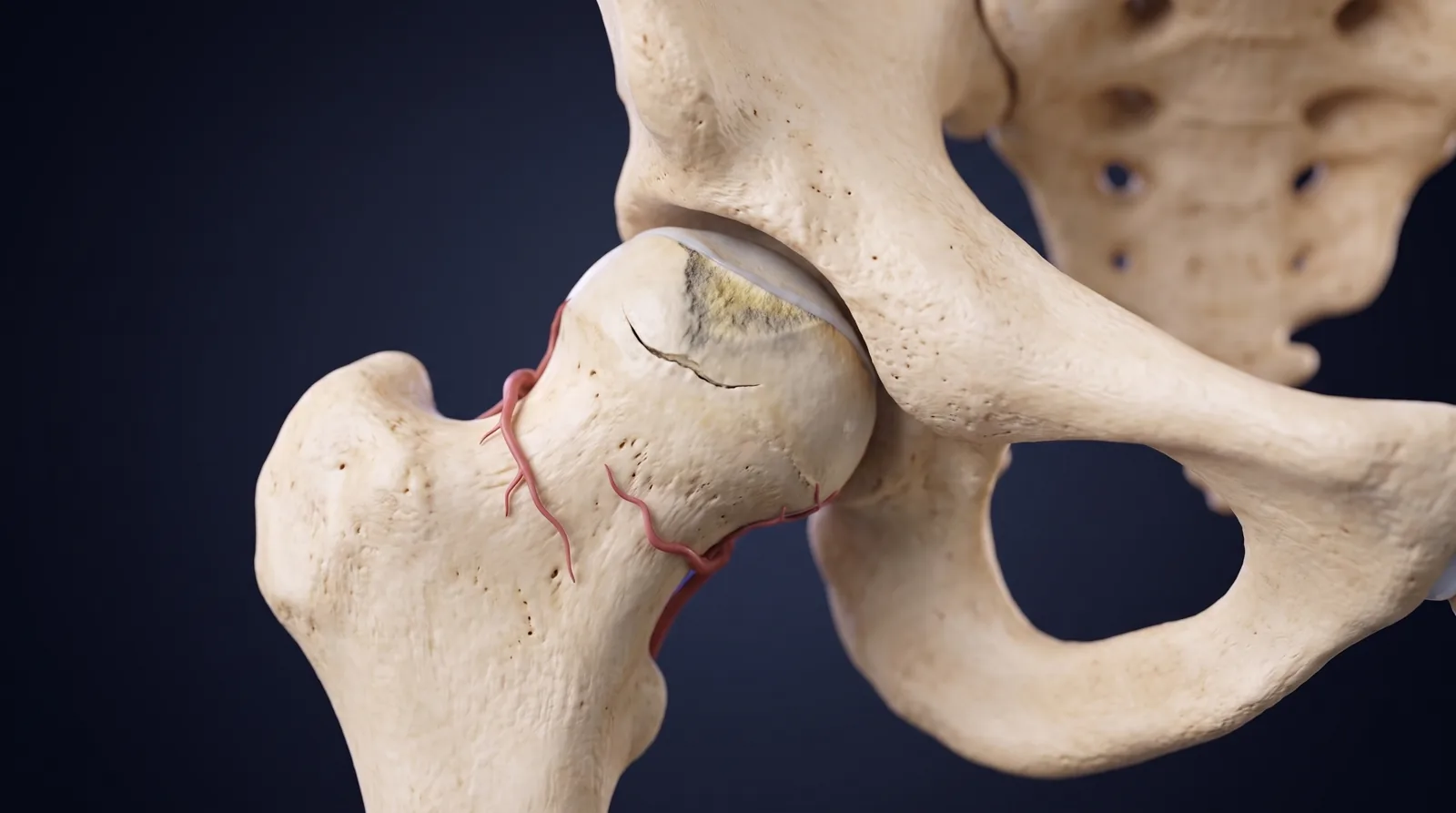
Avascular necrosis means bone tissue dying because its blood supply has been interrupted. In the hip it affects the femoral head, the ball at the top of the thighbone, and without timely treatment the joint can collapse.
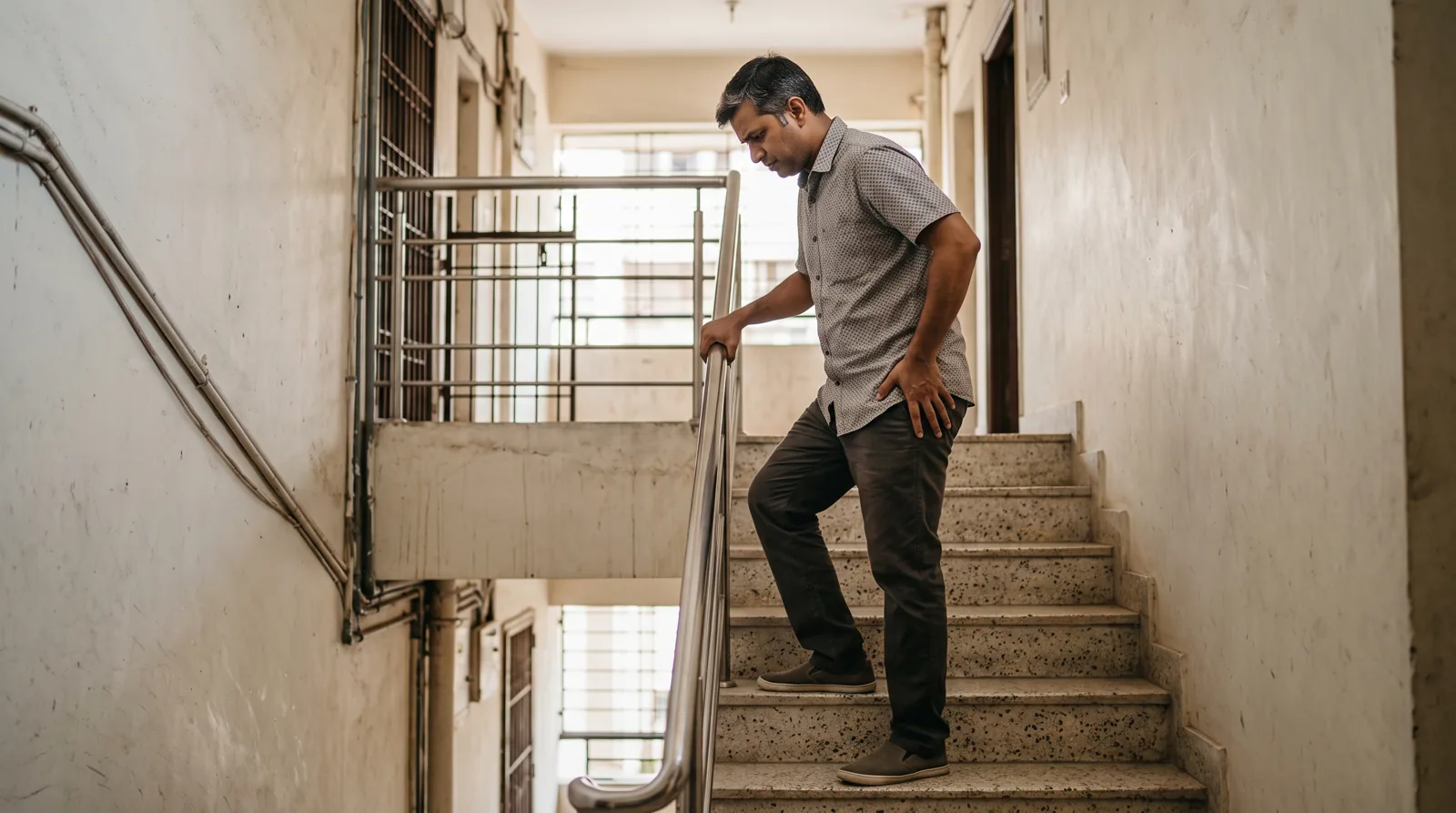
It usually starts as groin or hip pain with activity, then pain at night, a limp, restricted hip rotation, and difficulty with stairs or squatting. The most common cause in India is long-term steroid medicine; others are heavy alcohol use, hip injury or dislocation, radiation or chemotherapy, and sickle-cell and clotting disorders. Sometimes no cause is found. It often affects both hips.
Avascular necrosis stages: why your grade matters
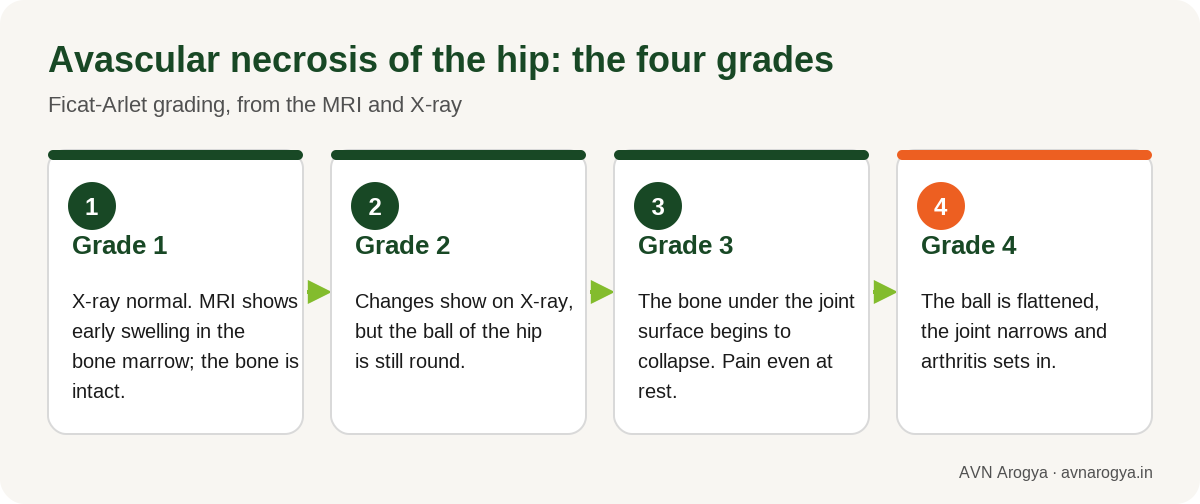
MRI is the gold standard: it can find AVN before anything shows on an X-ray. We grade the hip on the Ficat-Arlet scale, from Grade 1 to Grade 4.
- Grade 1 (silent stage). The X-ray is usually normal; MRI shows early swelling in the bone marrow, and the bone structure is intact.
- Grade 2. Changes are visible on X-ray, but the ball of the hip is still round.
- Grade 3. A "crescent sign" shows the bone just beneath the joint surface has begun to collapse, and the ball loses its roundness. Pain is present even at rest.
- Grade 4. The ball is flattened, the joint space narrows and arthritis sets in, with severe, disabling pain.
How Ayurvedic treatment for avascular necrosis works
We begin with the cause. A detailed history and a panel of blood tests show what contributed to your AVN, so each factor can be addressed. Then the programme is tailored to your grade, the risk of collapse, your age and how inflamed the hip is.
Internal medicines start in the first week to nourish the blood supply and support bone strengthening and healing and can include Guggulu formulations and address all underlying factors hampering optimal healing. The herbal formulae are made in-house and tested to international standards for heavy metals.
Inside the 21-day hip programme at AVN Arogya
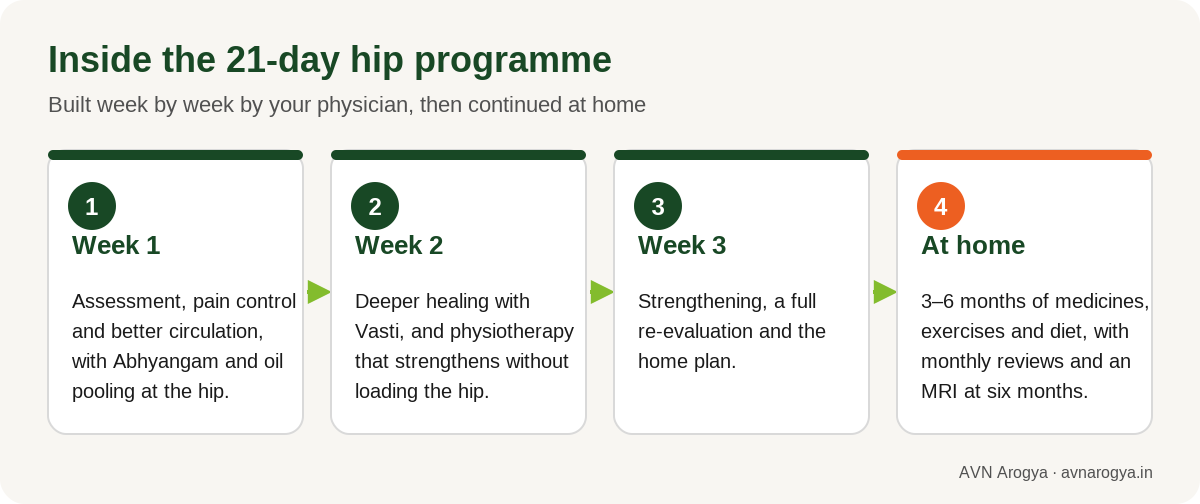
The first course of treatment is always a 21-day inpatient programme, extended when your physician judges it will help, followed by outpatient reviews.
- Week 1: pain control and circulation. A full assessment of your MRI grade, leg length, hip movement and walking, with a Harris Hip Score and pain score as a baseline. Targeted local therapies work to settle the swelling in the bone marrow and relieve groin and thigh pain, alongside Dhanyamla Dhara, the pouring of fermented liquid that helps reduce inflammation and reduce channel blockage, Podi Kizhi, a classical herbal bolus massage, and Ajavit Kizhi, a powerful pain-relieving poultice massage, along with Vasti (medicated enemas).
- Week 2: deeper healing and protecting the hip. Panchakarma intensifies — continuing with different Kizhis & Vastis as required in each case, to open up channels, improve blood flow, revive the micro-circulation, nourish the deep bone tissue and arrest the spread of the damage. Physiotherapy strengthens the buttock, thigh and core muscles without loading the hip, supported yoga keeps it flexible, and you learn to walk better.
- Week 3: strengthening and the home plan. Therapies to strengthen and stabilise the hip, a full re-evaluation, and discharge with a 3–6 month course of medicines for continued bone healing, home exercises, yoga and diet.
After you go home, monthly teleconsults and a repeat MRI at the end of one year to track the condition of the joint objectively, with an optional 10-14 day booster stay each year.
What you can expect, grade by grade
Many patients have their first real rest without pain by day three - five, and most of our patients feel meaningful pain reduction within 10 to 14 days of admission. For Grades 1 to 3, walking and daily activities typically improve to near-normal levels within 3 months and for grade 4, meaningful improvements happen within 3-6 months.
- Grades 1 and 2: in the majority of the patients we treat, progression is halted, with restoration of near-normal walking and activity level.
- Grade 3: many of our patients see significant improvement in function and pain and avoid hip replacement, with no further progression in stage.
- Grade 4: many of our Grade 4 patients gain meaningful improvement in function and have lived without a replacement for years; longer-term outcomes are still being recorded.
You can watch patients who were told surgery was the only option describe their recovery in their own words.
When is hip replacement needed for avascular necrosis?
We say this plainly. Grade 4 AVN with severe, intractable pain and real disability — such as being unable to walk or manage daily life despite a full course of treatment, followed faithfully — usually needs a total hip replacement. For healthy patients over 70, replacement is also a good choice. When surgery is the right path, we say so clearly and refer you to undergo surgery with full clarity of mind and support your recovery afterwards with Ayurvedic care. Choosing surgery then is not giving up; it is the right treatment.
Questions to ask before you agree to a hip replacement
- What grade is my hip, and on which scale? Ask for the Ficat-Arlet grade.
- Has the ball of the hip collapsed, and how much?
- Has my other hip been checked? An MRI can find early changes before they hurt.
- What caused my AVN, and is it being addressed? If you take steroids, do not stop them on your own — stopping suddenly can be harmful; but seek medical advice. We may be able to help you stop in some cases.
- How much should I walk in the meantime? Controlled weight-bearing may help in early stages, but too much walking or high-impact activity can worsen the damage.
Warning signs: Consult your doctor urgently if
- hip or groin pain suddenly becomes severe
- you suddenly cannot put weight on the leg
- the hip is hot and swollen, or you have a fever with hip pain
- pain follows a fall or injury

Frequently asked questions
How long can you live with avascular necrosis?
AVN of the hip is not life-threatening in itself; the real question is how long the hip will last. That depends largely on the grade at diagnosis, how early the right treatment starts, and how you follow the recommended protocol and self care.
Will my hip collapse completely?
Not necessarily. Diagnosed and treated early in a professional manner, the hip has the best chance of being preserved, and in the majority of the patients we treat for AVN, progression is arrested.
Should I try Ayurveda before a hip replacement?
Many patients choose an Ayurvedic evaluation first, especially in the early and intermediate stages. In most cases our treatment aims to relieve pain, improve function and preserve your natural hip, which may delay or reduce the need for replacement; if the damage is too advanced, we will tell you honestly. You can upload your MRI for a preliminary evaluation.
How long will I need to stay?
A minimum of three weeks as an inpatient; your physician advises the right length after assessment, and we can provide certificates for your employer.
If you have been told a hip replacement is the only option, get a second view from physicians who see the hip as something that can heal. Read about Ayurvedic treatment for avascular necrosis at AVN Arogya, or book a consultation — you can send your MRI and reports in advance.