


If you have early avascular necrosis (AVN) of the hip, you may be offered core decompression: "a small operation now, to save the hip later". It sounds reasonable, and for some people it is. But it is worth understanding what it does and does not do before you agree. Early AVN — exactly the stage at which core decompression is offered — is also the stage at which our non-surgical treatment does the most: in the majority of the patients we treat for AVN, progression is arrested without an operation.
What is core decompression?
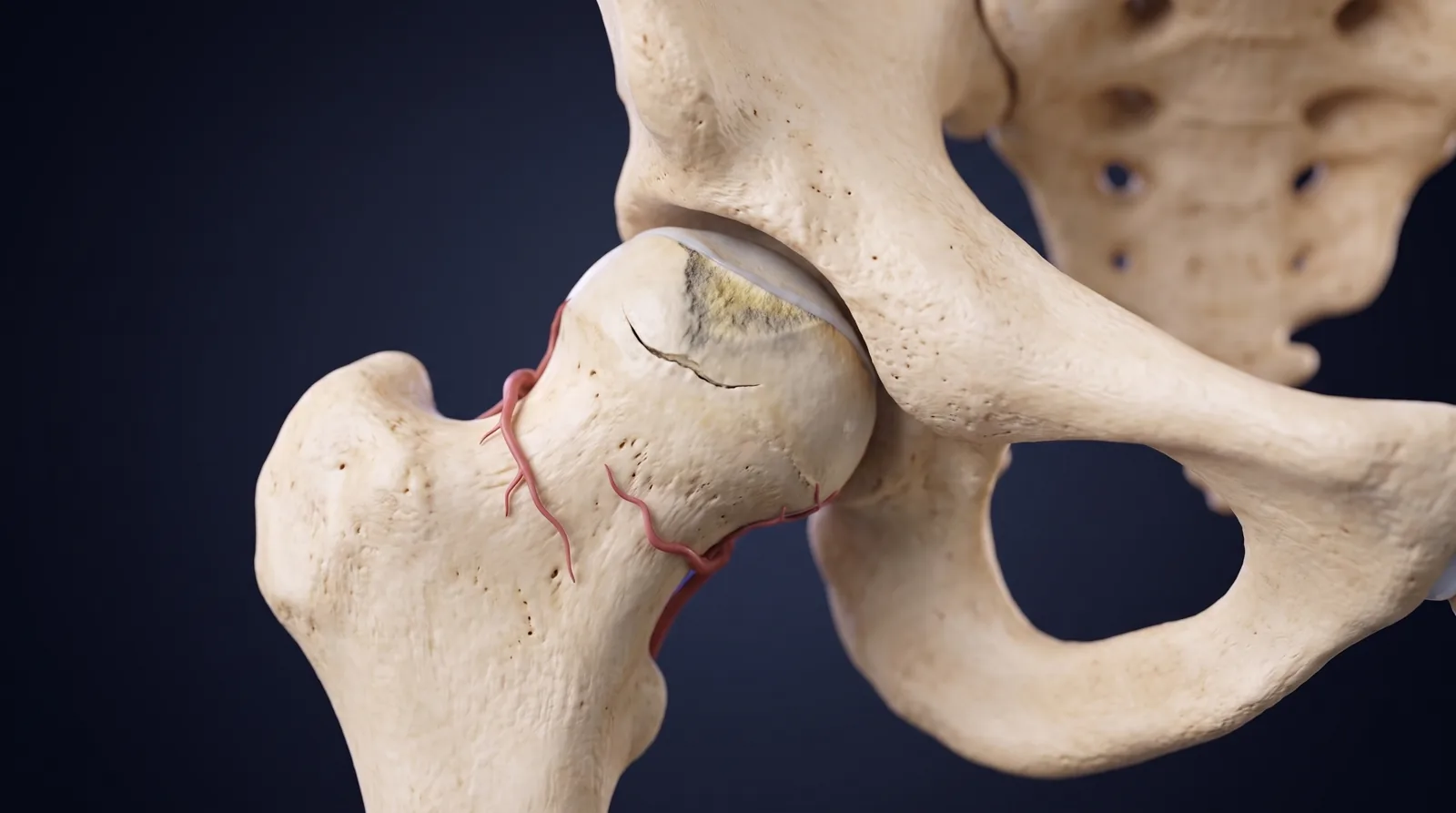
Core decompression is an operation on the ball of the hip (the femoral head). Under anaesthesia, the surgeon drills one larger channel, or several small ones, from the side of the thighbone into the area of dead bone. The idea is to relieve the raised pressure inside the bone, which is thought to contribute to pain and poor blood flow, and to encourage new blood vessels to grow into the damaged area.
The channel is sometimes filled with a bone graft, bone substitute or concentrated cells from the patient's own bone marrow, in the hope of improving healing.
When is core decompression for AVN considered?
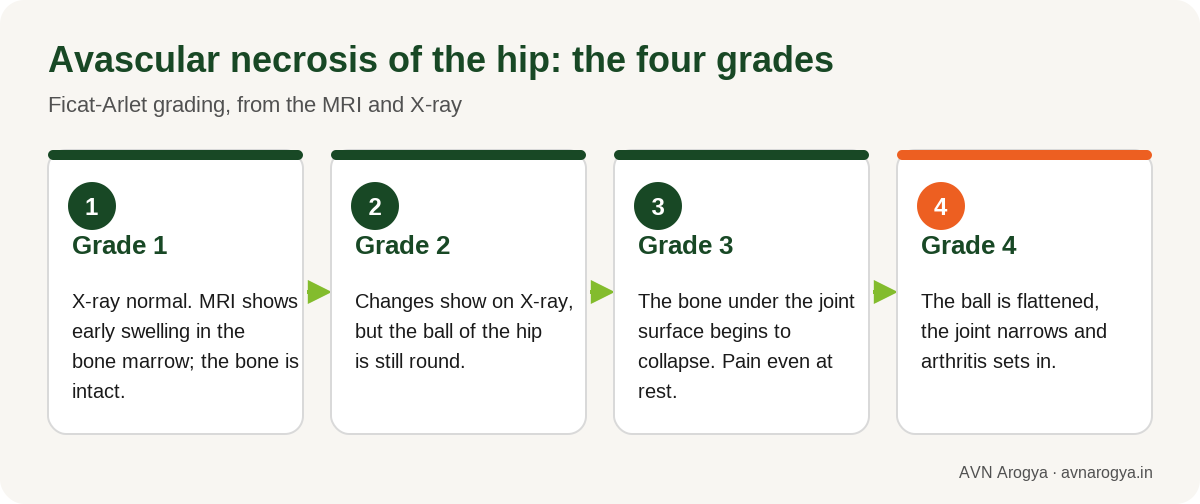
Core decompression is mainly used in the early, pre-collapse stages of AVN — Grades 1 and 2, when the ball of the hip is still round. It is generally less useful once the bone beneath the surface has collapsed (Grade 3, the crescent sign) or arthritis has set in (Grade 4).
Results vary with the size and position of the affected area: a small lesion away from the main weight-bearing part of the ball does better than a large one. Your report usually describes this; our guide to reading your hip MRI or X-ray report explains the words.
Recovery after core decompression
Recovery usually involves a short hospital stay and a period of protected walking with crutches, often for several weeks, so the drilled bone is not overloaded while it heals. As with any operation there are risks, including infection and, uncommonly, a fracture of the thighbone near the drilled channel. Some patients go on to need further surgery, including a hip replacement, if the AVN progresses.
What core decompression does not address
Core decompression works on the pressure inside the bone, mechanically. It does not, on its own, address why the blood supply failed — steroid medicines, alcohol, a clotting tendency, cholesterol, vitamin deficiencies or another condition. If those causes continue, the same hip, or the other hip, remains at risk; AVN often affects both hips.
The non-surgical option to weigh first: Ayurvedic treatment for early AVN
The body has a powerful capacity to heal, and Ayurveda strengthens it with medicines and therapies that work differently from modern drugs. At AVN Arogya, treatment begins with the root causes, found through a detailed history and a panel of blood tests, so each can be addressed. It then works to reduce inflammation, improve blood flow to the hip, strengthen the bone by supporting bone metabolism, and remove whatever is getting in the way of the body's natural healing.
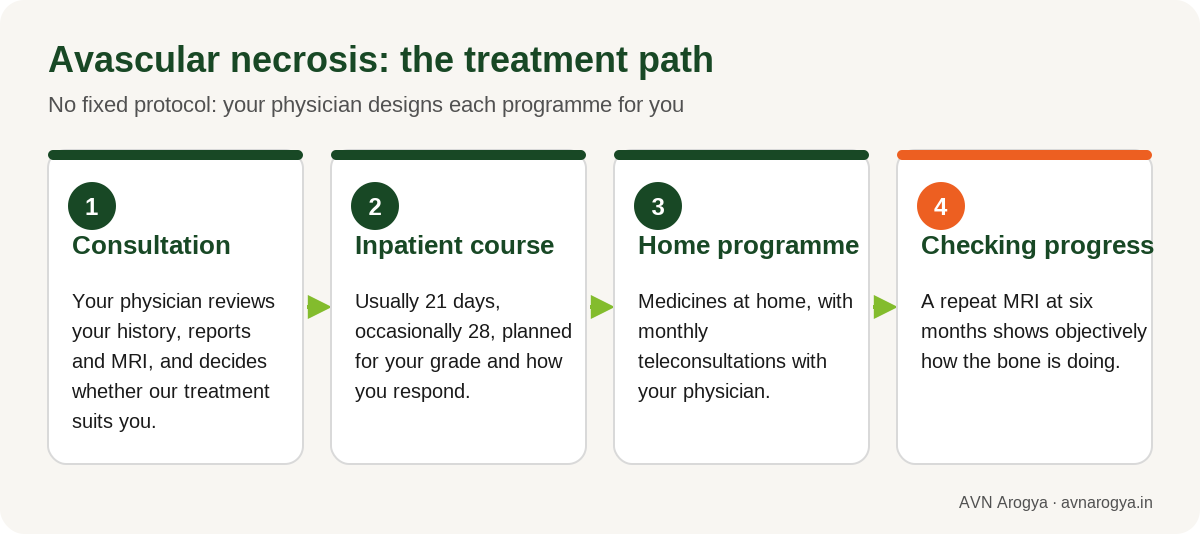
There is no fixed package. After a consultation in which your physician decides whether our treatment suits you, the first course is an inpatient programme, usually 21 days, designed personally for your grade, the risk of collapse, your age and how inflamed the hip is. It brings together our own medicines, made in-house and tested to international standards for heavy metals, classical therapies chosen for you, physiotherapy, supported yoga and diet. Physiotherapy strengthens the muscles around the hip without overloading it, and you learn to protect the bone with crutches or a walker while it heals.
In the majority of the patients we treat at Grades 1 and 2, progression is halted, with significant pain relief and recovery of function. Progress is checked objectively: a repeat MRI at twelve months, and an expert radiological and functional review a year after treatment. Occasionally, in early grades, we have even seen the damage reverse on repeat MRI; we do not promise it, but it shows what the body can do.
For an overview of every option, read Avascular necrosis treatment: every option, with and without surgery.
Questions to ask before you agree to core decompression
- What grade is my hip, and on which scale? Has any collapse begun?
- How large is the affected area, and where is it?
- What is the cause of my AVN, and how will it be addressed?
- Has my other hip been checked with an MRI?
- How long will I be on crutches, and when can I return to work?
- What happens if the AVN progresses after the operation?
- How urgent is the operation, and is there time to get a second opinion first? Ask your surgeon directly; the answer depends on your grade.
Frequently asked questions
Is core decompression a major operation?
It is smaller than a hip replacement, but it is still surgery under anaesthesia, usually followed by weeks of protected walking.
Does core decompression avoid a hip replacement?
In some patients it delays or avoids one, especially when done before collapse; in others the AVN progresses and a replacement follows.
Can I try Ayurvedic treatment before core decompression?
Many patients choose an Ayurvedic evaluation first, especially in the early and intermediate stages. Our physician will see your MRI and tell you honestly whether our treatment suits your hip.
I have already had core decompression. Can AVN Arogya still help?
Patients who have already had a core decompression can also be assessed; your physician will review your MRI after the operation and advise whether our programme suits you.
Seek urgent care if your hip pain suddenly becomes severe, if you suddenly cannot put weight on the leg, or if a wound or the hip becomes hot and swollen with a fever after surgery.
For an honest second opinion and a chance to avoid unnecessary surgery, consult an AVN Senior Physician and bring your MRI. Read about Ayurvedic treatment for avascular necrosis of the hip, or book a consultation — you can send your MRI and reports in advance.