


When every step sends pain down your leg, it is natural to fear that walking will make things worse. Usually it does the opposite: staying gently active, with short and regular walks, is better for sciatica than bed rest. If walking brings on heaviness or weakness, that is a signal to get the cause found, not to give up. At AVN Arogya we treat that cause, and in the majority of the patients we treat for sciatica, they walk freely again without surgery.
Is walking good for sciatica, or is rest better?
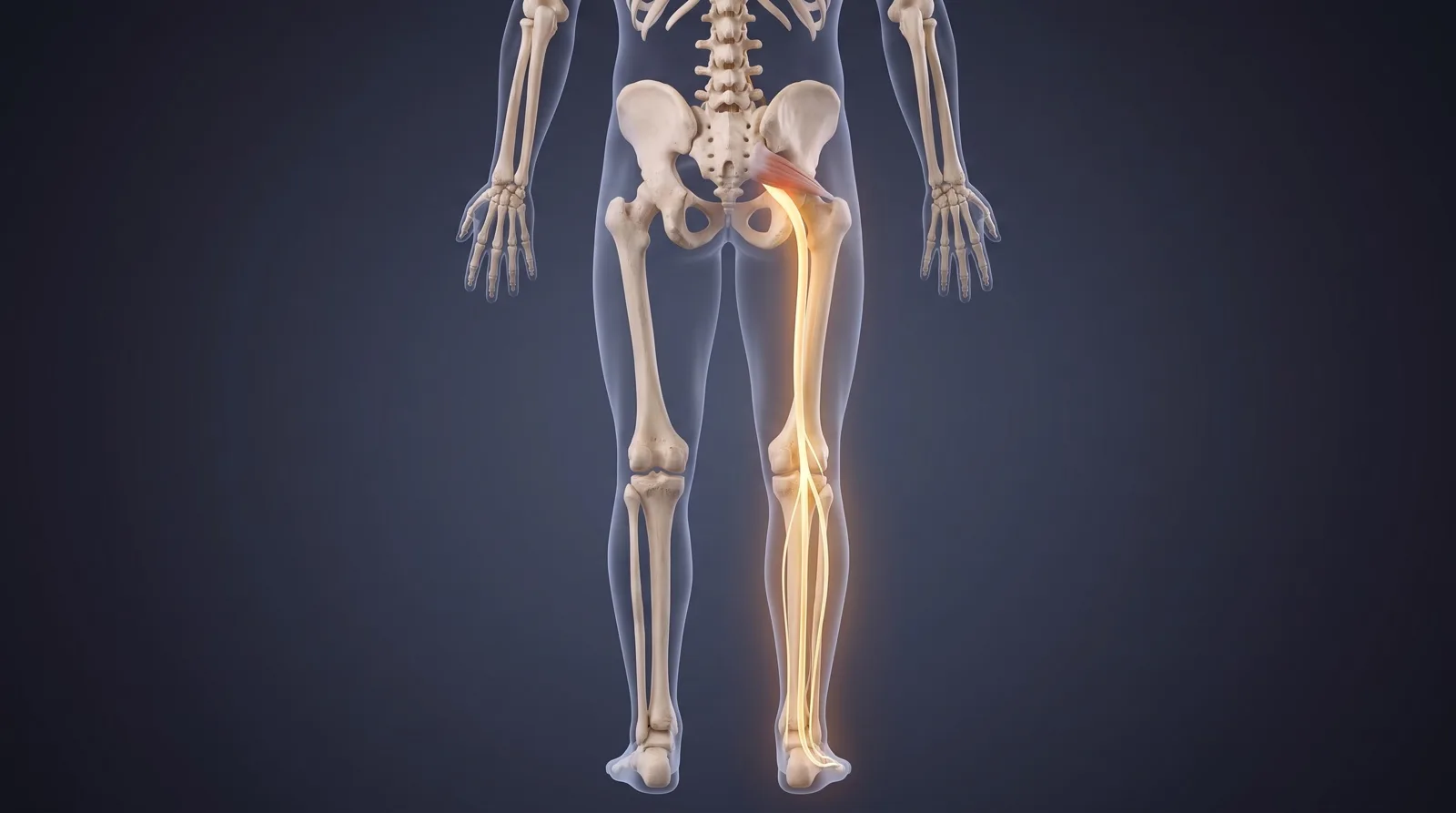
Sciatica is pain that travels from the lower back, through the buttock and down the leg. It usually comes from a disc, a narrowed spinal canal or a tight buttock muscle pressing on a nerve root, the point where a nerve leaves the spine.
Lying down all day feels safe, but long bed rest is not advised, and carrying on with normal activities as far as you can is the recommended approach. Long sitting and bending forward make sciatica worse, which is why many people find a short walk easier than a long sit.
How much should you walk with sciatica?
There is no single number that suits everyone. The right amount depends on the cause and how irritated the nerve is, and your physician and physiotherapist set it for you. These principles help in the meantime:
- Start small and build up. Begin with a few minutes at an easy pace on level ground, in flat, supportive footwear, and spread several short walks through the day rather than one long one. Add a little time every few days if your symptoms stay steady or improve.
- Watch the leg, not just the back. A mild ache in the lower back that settles soon after you stop is common. Leg pain, tingling or numbness that spreads further down the leg during or after a walk is a sign to cut back and tell your physician.
When does walking make sciatica worse?
A narrowed spinal canal (spinal stenosis)- Here walking can bring on pain and heaviness in the legs that builds the further you go, called neurogenic claudication. It typically eases when you sit down or lean forward, for example on a walking stick or a trolley. If this is your pattern, walking more is not the answer on its own; you need an assessment.
A severe flare- In a bad flare even a short walk can be too much, and pushing through the pain is not advised; ask your physician how much to do until it settles.
Weakness- If your foot catches or slaps on the ground, or your leg gives way, that is weakness, not pain, and it needs prompt medical attention.
What else helps sciatica pain day to day
- Avoid long sitting. Get up and move often, because sitting aggravates sciatica.
- Sleep in a supported position: on your back with pillows under your knees, or on your side with a pillow between them.
- Go easy on lifting and twisting while the pain is active; repeated lifting and twisting strain the lower back.
- Take your medicines as prescribed, and do not stop or change any of them without talking to the doctor who prescribed them.
These habits support recovery; they are not a substitute for assessment. Even sciatica that seems mild deserves a physician's view rather than being managed alone at home.
If walking is still hard: what Ayurveda can do
Many people are told to take painkillers and wait, or that surgery is next. Many of the patients we see arrive in exactly that place.
There is more that can be done. The body has a powerful capacity to heal, and Ayurveda strengthens it with medicines and therapies that work differently from painkillers. Our therapies work directly on the inflammation around the nerve root, the hydration of the disc and the protective muscle spasm that keeps the back locked.
Sciatica treatment at AVN Arogya, step by step
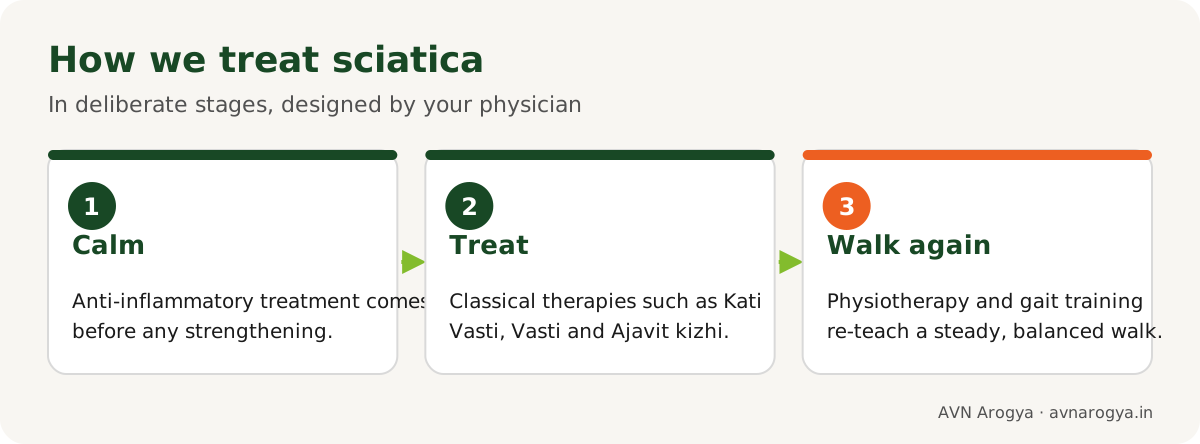
It begins with a physician who gives you a patient hearing. A consultation assesses and advises; your physician then decides the right pathway with you. Diagnosis usually includes a straight-leg raise test and an MRI of the lower spine, with nerve-conduction studies for long-standing cases.
When a programme is needed, AVN treats sciatica without surgery, usually through a 14–21 day inpatient stay. There is no fixed package: your physician designs it around the stage of your condition, how inflamed the nerve is and how you respond, an approach refined across four generations of AVN practice.
- Calm the inflammation first. Anti-inflammatory treatments such as Ajavit kizhi, Podikizhi, Elakizhi come before any kind of strengthening.
- The classical therapies. These can include Kati Vasti, our signature therapy for the lower back, in which warm medicated oil is held over the lumbar spine; Vasti, a medicated enema and the most versatile of the Panchakarma procedures.
- Rebuild and walk again. Physiotherapy is built into the programme to improve the mechanics of the lower back and core. Our physiotherapists use therapeutic exercise, manual therapy and gait training, which re-teaches a steady, balanced walking pattern. Gentle stretches and therapeutic yoga, prescribed for your condition, are added step by step.
You go home with a home protocol of medicines, exercises and posture guidance, so the healing continues. Our medicines are made in-house and tested to international standards for heavy metals.
Will I walk normally again?
Our patients typically describe the leg pain easing first and sitting becoming easier, with numbness improving more gradually over four to eight weeks. Many of our patients with spinal stenosis find their leg pain reduces and their walking distance improves with treatment. In our experience, most sciatica responds well to this care, and surgery is rarely needed. Progress is measured with pain scores and the Roland-Morris disability questionnaire, not assumed.
You can watch our patients' recovery stories in their own words.
When is surgery needed for sciatica?
We say this plainly. Weakness that is getting worse, foot drop, or loss of bladder or bowel control needs urgent surgical referral, as does pain that will not settle despite proper conservative care. We work with leading orthopaedic and specialist surgeons and refer without delay when that is the right path.
Warning signs: see a doctor urgently if
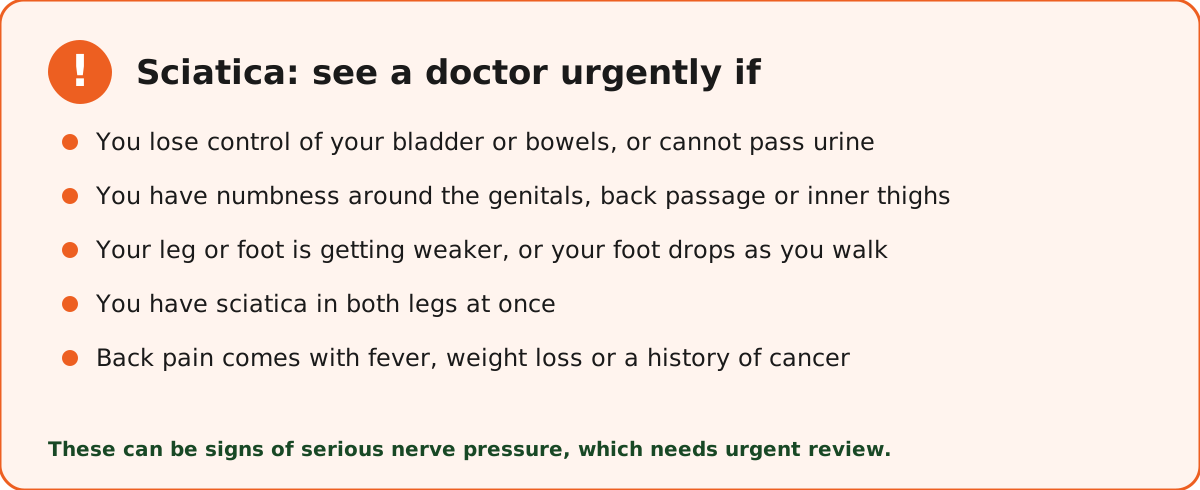
- you lose control of your bladder or bowels, or cannot pass urine
- you have numbness around your genitals, back passage or inner thighs (the "saddle" area)
- your leg or foot is getting weaker, or your foot drops or slaps as you walk
- you have sciatica in both legs at once
- you have back pain with fever, unexplained weight loss or a history of cancer
Frequently asked questions
Can walking make sciatica worse?
It can, particularly when a narrowed spinal canal is the cause, where leg pain and heaviness build the longer you walk. Stop and get assessed if walking makes the leg pain spread or brings on weakness.
How long should I walk with sciatica?
There is no single figure. The right amount depends on the cause and is set by your physician and physiotherapist, who design exercise specific to your needs.
What should I do for sciatica pain right now?
Keep moving gently, avoid long sitting, sleep in a supported position and take any prescribed medicines as directed. Then book an assessment, so the cause is found and treated, not only the pain.
Can sciatica heal without surgery?
In the majority of the patients we treat, yes: the inflammation settles, the nerve recovers and the supporting muscles are rebuilt, without an operation.
If sciatica is shrinking your world to the distance you can walk, and you have been told to live with it or that surgery is next, get a second view from physicians who see the nerve as something that can heal. Read about Ayurvedic treatment for sciatica at AVN Arogya, or book a consultation. You can send your MRI and reports in advance.