
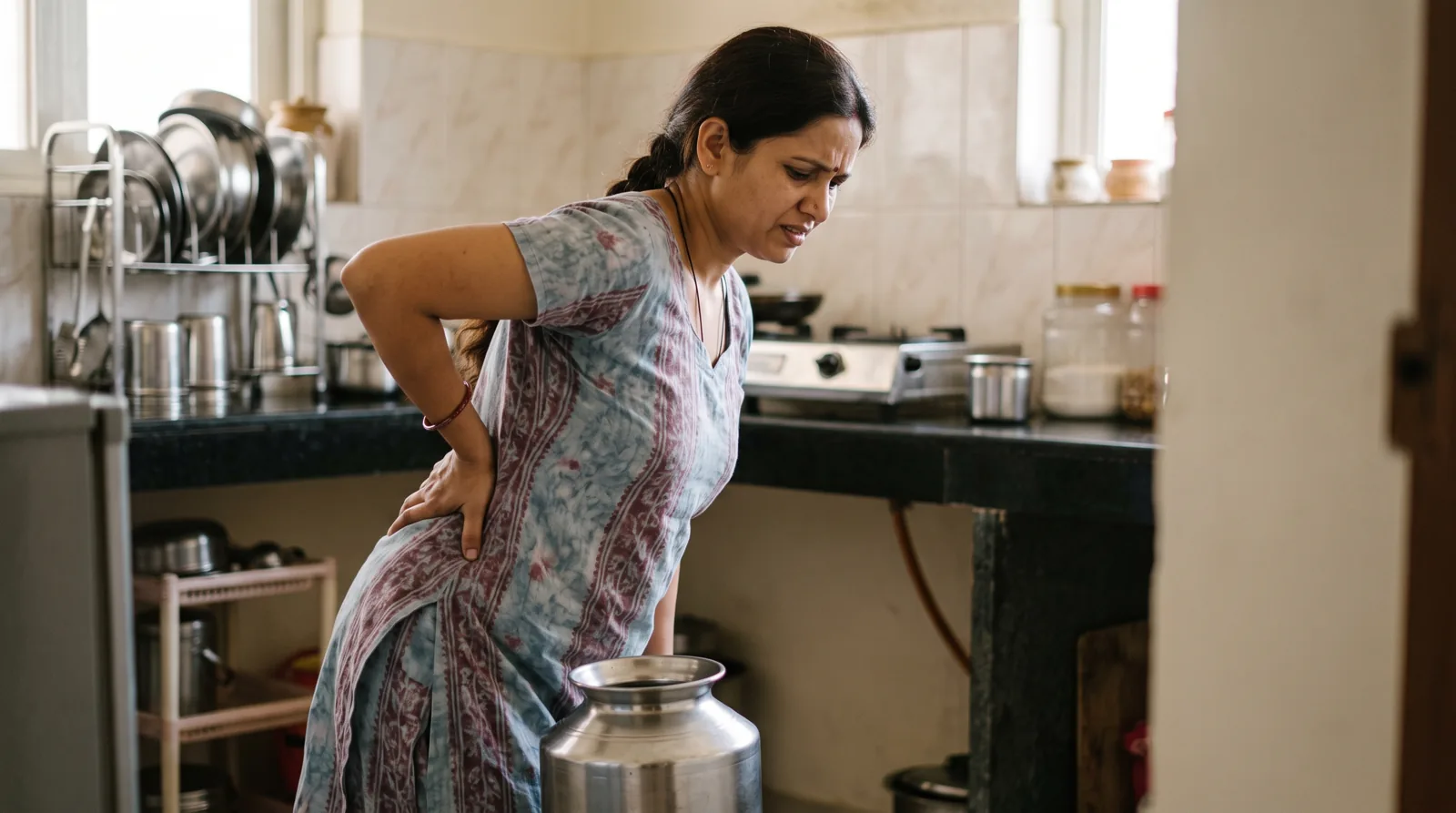
An MRI report that says "disc bulge" or "disc herniation" can feel like a life sentence: a back that will never be the same, and surgery waiting at the end. It need not be. The pushed-out part of a disc often shrinks back over time, the inflamed nerve can settle, and the back can be made strong again. At AVN Arogya our non-surgical programme is highly effective even for large disc extrusions, and the majority of the patients we treat for a slipped disc recover without an operation.
What is a slip disc, and how is it different from a disc bulge?
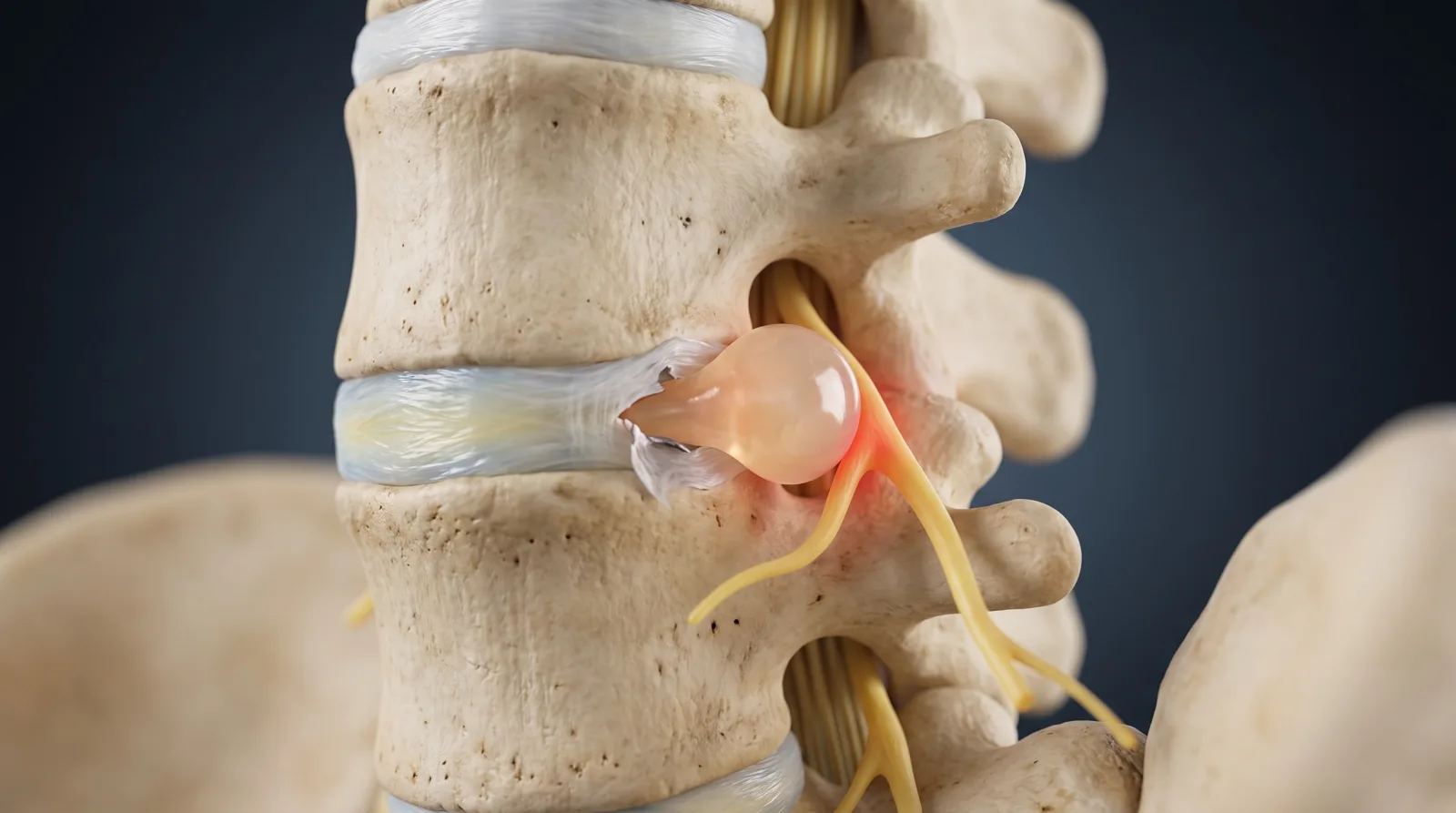
Between each pair of bones in your spine sits a disc: a cushion with a tough outer ring and a soft centre. A "slip disc" does not actually slip out of place. The soft centre pushes through the outer ring and presses on a nerve root, causing lower back pain that spreads down the leg (sciatica), with tingling, numbness or weakness. Doctors call this a disc herniation or disc prolapse.
A disc bulge is a milder change: the disc spreads a little beyond the edges of the bones while its outer ring stays intact. Bulges are common on MRI, even in people with no back pain, so a bulge on your report is not automatically the cause of your pain; it has to match your symptoms and your examination. That is why our physicians examine you — the straight-leg raise, mapping of sensation along the leg, and muscle-strength testing — alongside the MRI.
Common contributors are poor posture and long sitting, repeated lifting or twisting, age-related disc wear, excess weight with weak core muscles, and incorrect gym technique.
Can a slipped or bulging disc be reversed?
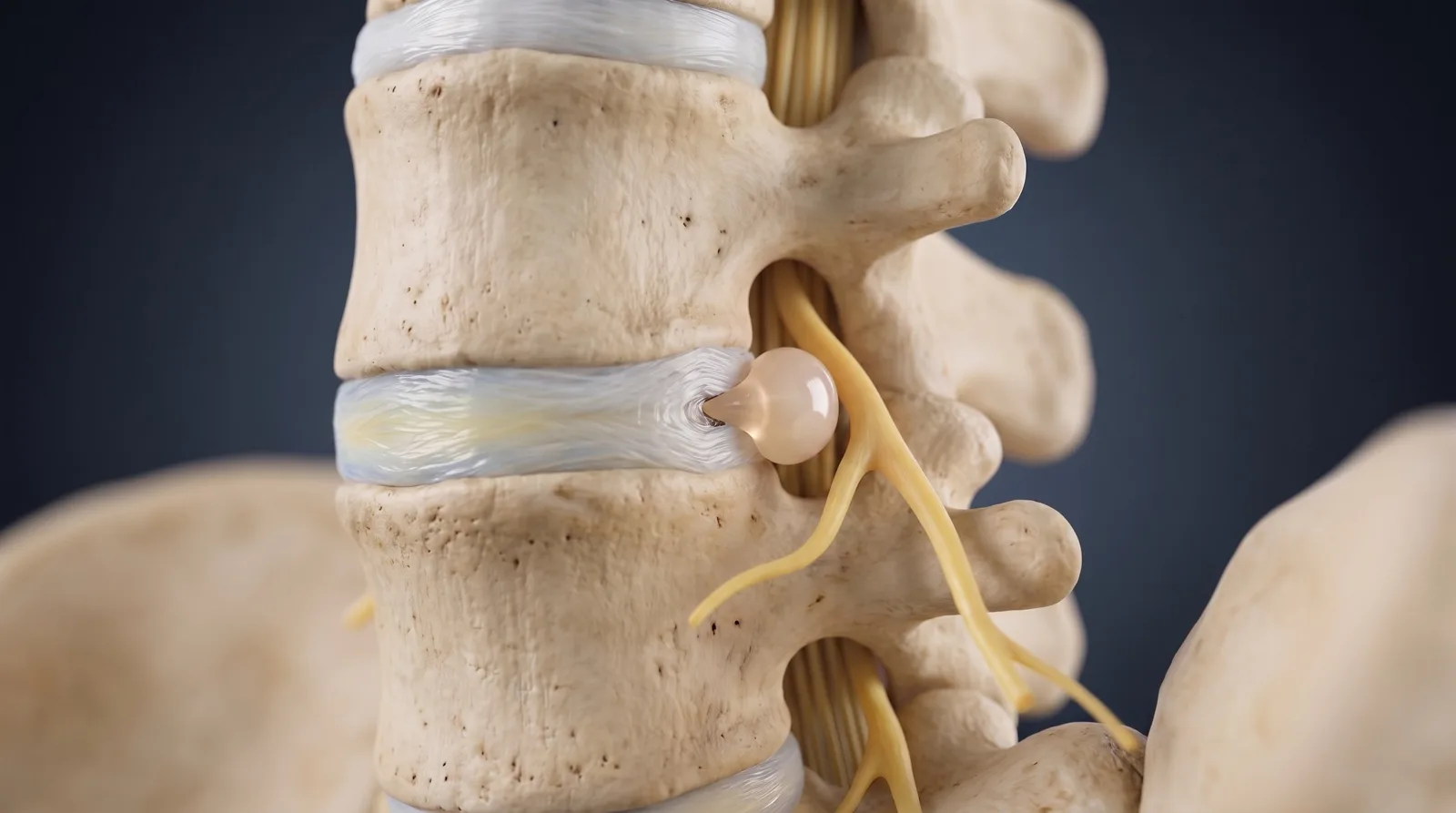
More can change than you may have been told:
- The pushed-out portion can shrink. The herniated part of the disc often shrinks naturally, through a process called resorption.
- The nerve can settle. Much of the pain comes from inflammation around the nerve root, and that inflammation can be calmed.
- The disc can be supported. Our therapies and internal medicines aim to support disc hydration, and where the disc is degenerating, our aim is to arrest further progression.
- The back can be made strong again. Rebuilding the core and back muscles takes load off the disc.
When we repeat the MRI at six months in more severe cases, most of our patients show improvement or arrest on the scan.
What does not change is age itself: the natural drying of a disc over the years does not turn back. And you do not need a perfect scan to be well — it is common to feel fully recovered while a later MRI still shows some bulge.
Is surgery the only answer?
Most patients who come to our spine team arrive in pain, often after months of treatment the results of which did not last, or with surgery already recommended. Will the disc get worse without an operation? In most cases, no. What matters is proper treatment during this period: reducing the inflammation, protecting the nerve and strengthening the supporting muscles.
The body has a powerful, built-in capacity to heal, and Ayurveda strengthens it with medicines and therapies that work differently from painkillers. Many of our patients who were advised spine surgery have recovered without it, including many with large disc extrusions.
How Ayurvedic treatment for a slip disc works
Personalised Ayurvedic therapies, physiotherapy and internal medicines work together to reduce the inflammation around the nerve root and support disc hydration. The order is deliberate. Anti-inflammatory measures come first; rebuilding therapies are introduced only when appropriate, and an inflamed back is never pushed into strengthening at the outset.
Physiotherapy eases the mechanical compression and improves core mechanics, while gentle stretches and therapeutic yoga, introduced progressively under supervision, release the deep muscle spasm acting on the nerves.
Slip disc treatment at AVN Arogya, step by step
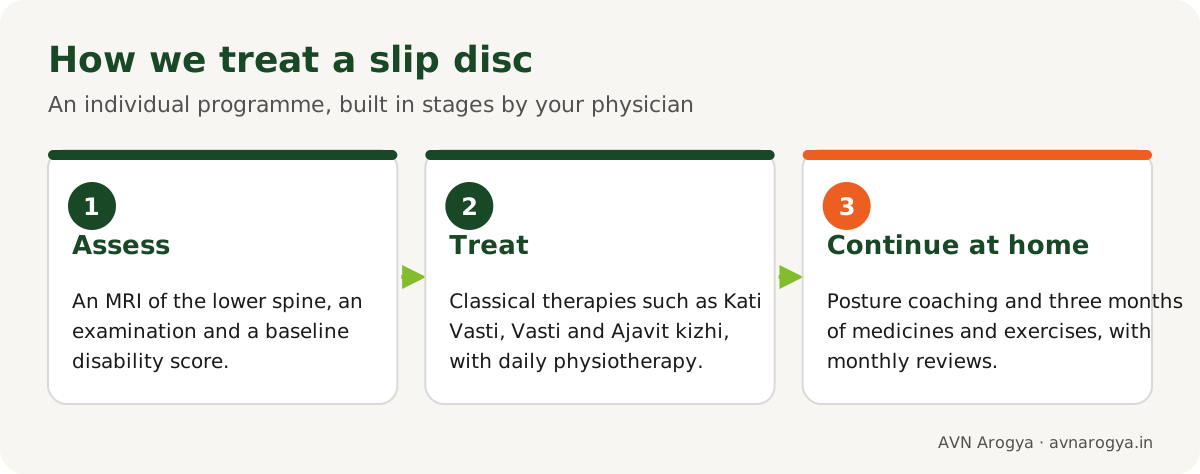
There is no fixed package. Every programme is designed personally by your physician around the stage of your condition, the current level of inflammation, your constitution and how you respond.
- Assessment. An MRI of the lumbar spine, a clinical examination and a baseline Roland-Morris disability score, after which your physician advises inpatient care, outpatient care or, when it is genuinely needed, a surgical referral.
- The classical therapies. After an acute-phase pain-relief protocol in the first days, a 14–21 day inpatient programme combining Panchakarma, localised Vasti therapies and daily physiotherapy. This can include Kati Vasti, our signature therapy for the lower back, in which warm medicated oil is held over the lumbar spine in a dough dam; Vasti, the medicated enema that is the most versatile of the Panchakarma procedures; Ajavit kizhi, a dry bolus therapy designed to relieve severe sciatic pain and deep nerve compression; and Manjal kizhi, a warming fresh-turmeric bolus massage that eases local swelling.
- Going home. A functional re-assessment, posture coaching and a three-month home protocol of medicines and exercises, with monthly teleconsult reviews.
Your medicines are purely herbal speciality formulations, made at our own GMP-certified facility and tested to international standards for heavy metals.
How soon will I feel better?
Most of our patients feel significant pain reduction within 7 to 10 days. With a bulging disc, the bulk of the pain relief usually comes within two to three weeks; with a herniated disc, improvement is significant over three to six months as healing continues at home. Progress is measured, not assumed.
Many of our patients could barely walk when they arrived; you can watch their stories in their own words.
Will it come back?
A slip disc can recur, particularly when the factors behind it — poor posture, weak core muscles, poor lifting technique, excess weight and long hours of sitting — are left as they were. That is why our treatment includes posture correction, ergonomic advice, therapeutic exercise and lifestyle changes, not pain relief alone. When patients keep up the home-exercise protocol, recurrence is low in our experience.
When is surgery needed for a slipped disc?
We say this plainly. Surgery is the right path for progressive weakness in the leg or foot drop; for cauda equina syndrome, where the nerves to the bladder and bowel are compressed, which needs urgent surgical referral; and when symptoms keep worsening through a 3–6 month supervised non-surgical trial. We maintain transparent referral relationships with leading orthopaedic and spine surgeons, and if surgery is the most appropriate treatment for you, we will say so.
Warning signs: see a doctor urgently if
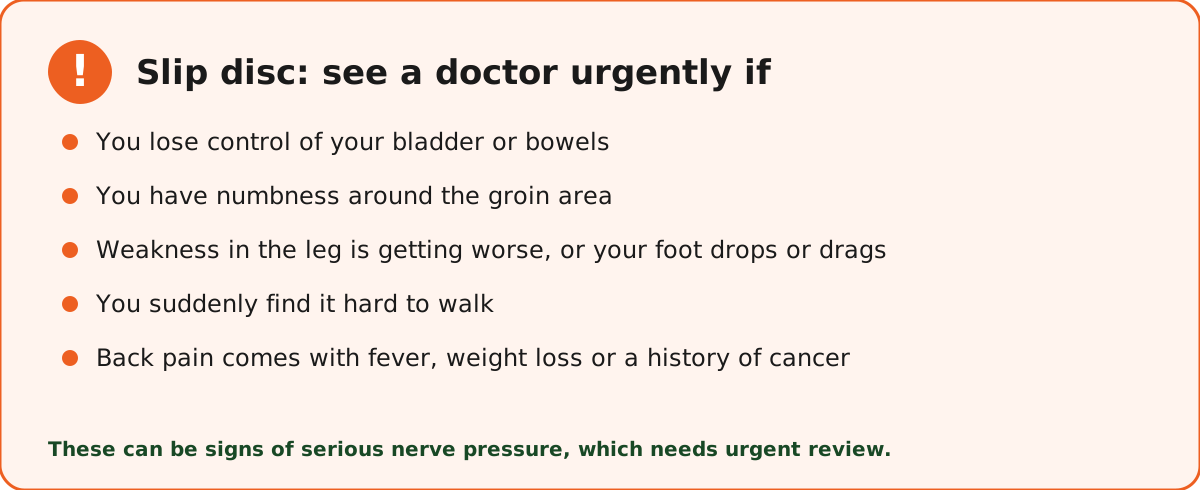
- you lose control of your bladder or bowels
- you have numbness around the groin area
- weakness in the leg is getting worse, or your foot drops or drags
- you suddenly find it hard to walk
- back pain comes with fever, unexplained weight loss, or a history of cancer
Frequently asked questions
Is a disc bulge curable?
The age-related change behind a bulge does not reverse, so no honest doctor promises a "cure". But the pain it causes can settle, and in the majority of the patients we treat for a painful disc bulge, it settles without surgery. A bulge that causes no symptoms may need no treatment at all.
Can a slip disc heal without surgery?
In most suitable cases, yes. Our physicians assess your history, examination and MRI to judge whether you are likely to benefit; when you are, treatment aims to relieve pain, reduce nerve irritation, restore movement and return you to daily life without surgery.
Which exercises help, and which should I avoid?
Walking, gentle stretching and the stabilising exercises your doctor prescribes usually help. Avoid heavy lifting, high-impact sport, repeated bending or twisting, and anything that clearly increases back or leg pain until your doctor advises otherwise.
Does my weight affect my disc?
Yes. Extra weight adds stress to the lower back, and weight management, with dietary guidance and exercise, is part of our treatment.
If you have been told your disc will only get worse, or that surgery is next, get a second view from physicians who treat the spine as something that can heal. Read about Ayurvedic treatment for a slipped disc at AVN Arogya, or book a consultation — you can send your MRI and reports in advance.