


Many families assume they must pay for Ayurvedic care themselves, and some delay treatment because of it. They need not. Inpatient Ayurvedic treatment is insurable in India, and at AVN Arogya it can be cashless or reimbursed under the health policy you already hold. Our insurance desk checks your exact cover before you are admitted, so you know what your policy pays and what, if anything, you pay — before you commit.
Does health insurance cover Ayurvedic treatment in India?
Yes. Since IRDAI's standardisation of health insurance in 2020, Indian health policies are expected to cover AYUSH treatment — Ayurveda, Yoga, Unani, Siddha and Homoeopathy — when it is taken as inpatient care in a hospital that meets the policy's definition of an AYUSH hospital. Treatment at a NABH-accredited AYUSH hospital qualifies under most health policies, and our Madurai hospital is NABH accredited.
This matters for the conditions we treat most. A disc prolapse, avascular necrosis, an active rheumatoid flare, severe osteoarthritis or spine condition often needs a structured inpatient programme, not a few outpatient visits — and that programme is exactly what your policy is designed to cover.
What Ayurvedic treatment does insurance cover?
At AVN Arogya, conditions covered for inpatient treatment include avascular necrosis, lumbar disc prolapse, cervical spondylosis that needs inpatient care, advanced knee osteoarthritis, active rheumatoid arthritis, frozen shoulder, sciatica with nerve compression and ankylosing spondylitis.
Depending on your policy, the expenses that can be covered include:
- room charges
- physician consultation fees
- Panchakarma and Kerala therapy charges
- Ayurvedic medicines given during your stay
- diagnostic tests such as blood work and imaging
- nursing and attendant charges
- physiotherapy sessions
- discharge medicines, as your policy allows
Coverage always depends on your own policy terms, and our insurance desk confirms it before admission.
Is outpatient Ayurvedic consultation covered by insurance?
Usually not. Most standard health policies in India cover inpatient treatment only; some comprehensive and corporate group plans include outpatient benefits. Your first consultation is where a physician assesses you and decides whether an inpatient programme is needed.
How cashless Ayurvedic treatment works at AVN Arogya
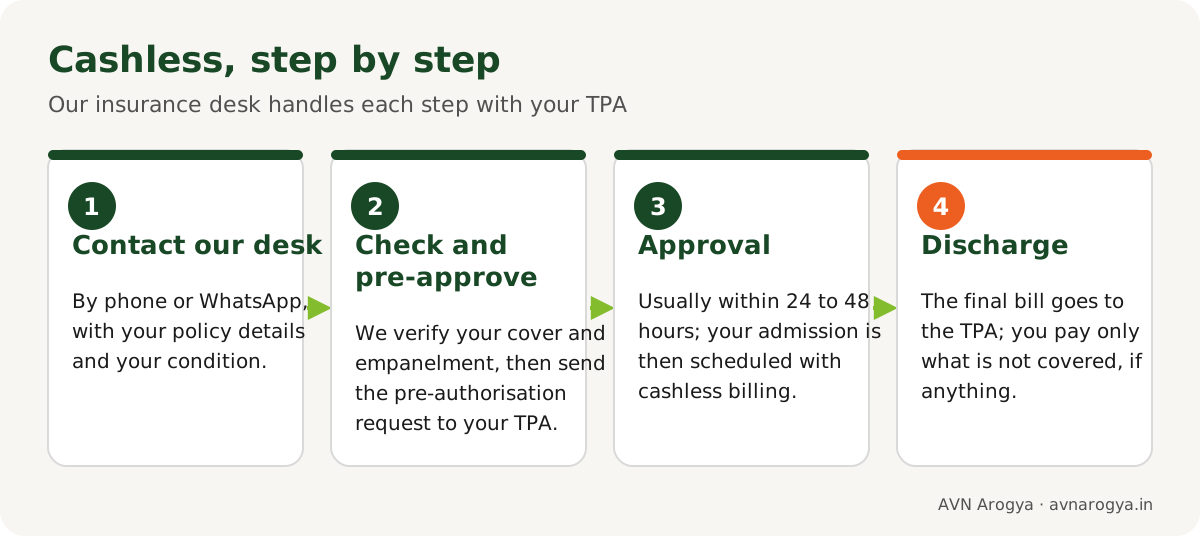
AVN Arogya is empanelled with more than 35 insurance companies and TPAs across India, including most major private and public-sector insurers. The process is simple, and we handle the paperwork:
- Contact our insurance desk by phone or WhatsApp with your policy details and your condition.
- Eligibility check — we verify your cover and your TPA's empanelment.
- Pre-authorisation — we send the request, with your medical details, to your TPA.
- Approval — usually within 24 to 48 hours, after which your admission is scheduled with cashless billing.
- Discharge — the final bill goes to the TPA, and you pay only what is not covered, if anything.
Send your request three to five working days before your planned admission, so approval is in hand when you arrive.
If your insurer is not on our list, you can still claim reimbursement. We give you all the records, bills and discharge summaries in the format insurers ask for.
Will insurance cover my room?
Room cover depends on your sum insured and your policy's room-rent limit. Most policies cover our Economy, executive & Deluxe rooms in full, while most comprehensive higher limit policies cover even a private villa. However, it will depend upon your room charge limit as per the policy and the specific terms of your insurer. If you choose a room above your limit, the difference is yours to pay — so we give you a full cost breakdown, with the expected co-pay, before you commit. All our rooms are private.
If you prefer to pay yourself, or to cover a balance, interest-free EMI over 3 to 18 months is available for inpatient treatment in Madurai, and it can be combined with insurance.
What to check on your own policy
- whether your policy has an AYUSH sub-limit, and how much
- the waiting period for your condition, especially if it was present before the policy began
- your room-rent eligibility per day
- whether your insurer or TPA is on our empanelled list, which decides cashless or reimbursement
You do not have to work this out alone. Send us your policy details and our desk will check your eligibility within 24 hours.
Are wellness and rejuvenation stays covered?
No. Insurance covers treatment that is medically necessary, with records to show it. Wellness, rejuvenation and preventive programmes are not insurable admissions, and they should never be presented as if they were. If anyone suggests presenting a wellness stay as a medical admission to obtain cover, that is insurance fraud, and AVN Arogya will not do it.
Frequently asked questions
Is Panchakarma covered by health insurance?
When Panchakarma and Kerala therapies are part of a medically necessary inpatient programme, their charges can be covered under your policy terms. A Panchakarma stay taken for wellness alone is not covered.
How long does cashless approval take?
Usually 24 to 48 hours after all documents are submitted. We recommend starting three to five working days before admission.
What documents do I need?
Your policy copy, TPA health card, Aadhaar and PAN card or passport, a recent photograph, your MRI, X-ray and blood reports, previous treatment records and a referring doctor's letter if you have one. We provide the pre-authorisation form.
My insurer is not empanelled. Can I still claim?
Yes, by reimbursement. You pay at discharge and claim with the records, bills and discharge summary we prepare in the format your insurer needs.
Will insurance pay for my medicines after discharge?
Discharge medicines are covered only as your policy terms allow; our insurance desk will tell you before you are admitted.
Insurance should not stand between your family and the care you need. See insurance and cashless treatment at AVN Arogya and the list of insurers we work with, or book a consultation — send your reports and policy details in advance, and we will tell you what your cover is likely to pay before you travel.